
By Sarah Shrader, health & wellness reporter
Protein is the latest health craze in the U.S. However, the exponential rise in protein-marketed products and consumption has experts warning that this may have gone too far.
“Now, protein is part of the marketing environment,” stated Vivica Kraak, who holds a doctorate and is an associate professor of food and nutrition policy at Virginia Tech University. “It’s the new gluten-free.”
CBS news reports that last year, 61% of Americans increased their protein intake. Industries took notice, as protein-centered products popped up in the forms of Starbucks’ Protein Cold Foam, Dunkin Donuts’ Protein Refreshers, and Kroger’s Simple Truth Protein Line.
Hyper protein consumption is a predominantly younger facing health trend. Younger generations, such as Millennials and Generation Z, on average, spend $71 on protein items (meat, dairy, powders, chips, etc.) per week, whereas older generations tend to spend about $27, according to Empower’s recent “The Protein is Extra” study.
Additionally, 43% of Americans reported that they are willing to pay higher prices for protein-enhanced items. That percentage is higher among Generation Z, 56% of whom reported splurging on protein goods. The study further affirms Americans’ protein preference; it found that 50% of respondents check protein content first when reading nutrition labels, and that 45% consciously look for protein-labeled items.
The muscle-building macro further solidifies itself as a health stamp of approval as 72% of study respondents reported that if a product is labeled as protein-enhanced, they are more likely to pay extra. A majority of respondents also stated that they are looking to increase their protein intake – enter Simple Truth Protein Line.
Launched on September 17, 2025, and marketed as an affordable and “free from unwanted ingredients” protein option, Kroger’s Simple Truth brand offers more than 110 protein-enhanced grocery items.
The line boasts everyday products enhanced with whey, pea, and various concentrated protein sources. Additionally, products that are already protein-rich are featured, like Simple Truth’s protein cottage cheese. Their version sports 15 grams per ½ cup serving, in juxtaposition to Good Culture’s 14 grams for the same serving size.
Other merchandise includes, but is not limited to:
- Protein Water
- Protein Cereal
- Protein Waffles
- Protein Peanut Butter
- Protein Crackers
- Protein Bagels
- Protein Rice
- Protein Coffee
- Protein Chicken Bites
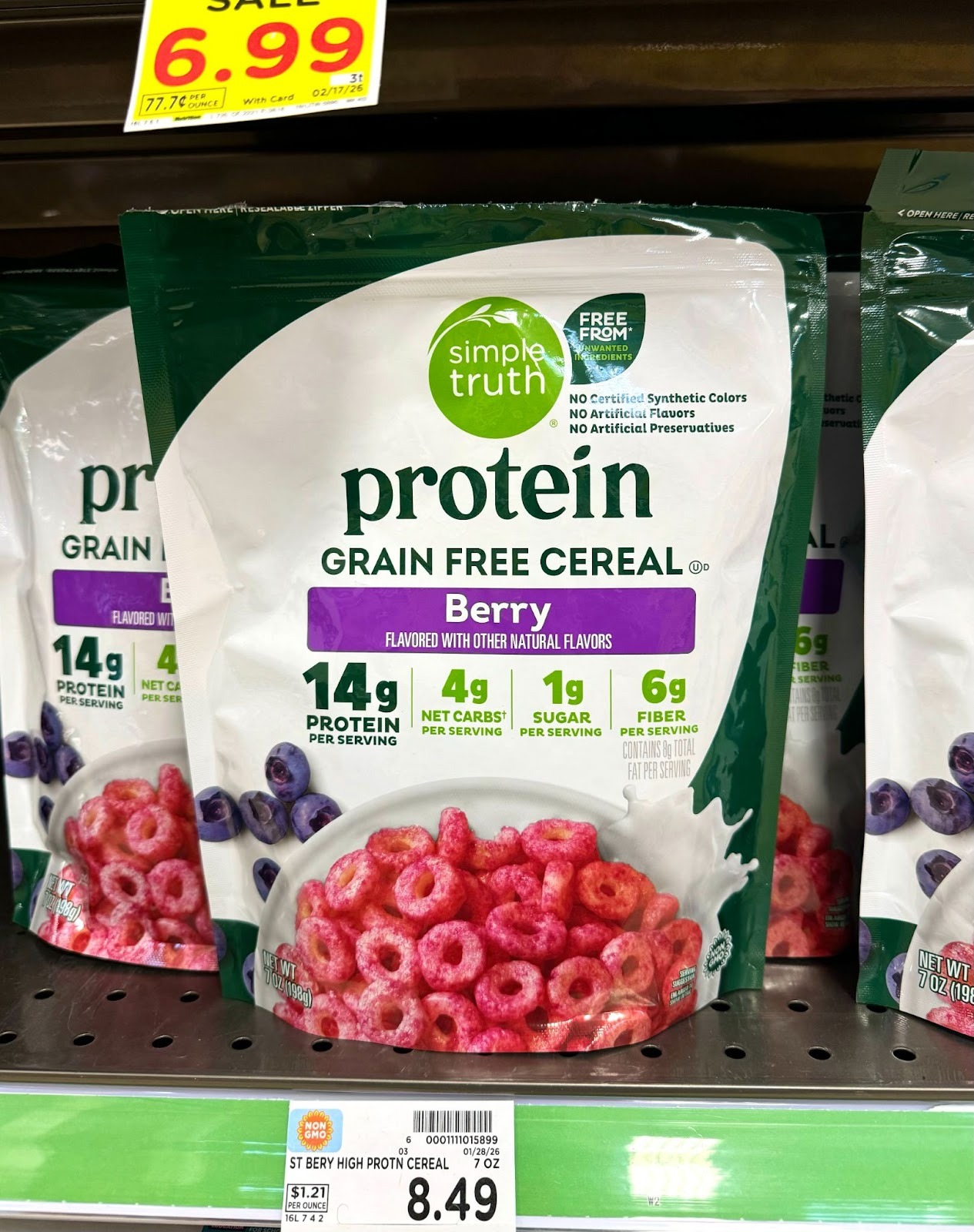
Simple Truth Protein’s grain free berry flavored cereal on grocery store shelf. (photo by Sarah Shrader TheNewsFeedNRV.com)
The Simple Truth Protein Line appeals to health-conscious consumers, looking to eat right. While it may be grocery supplies, the line is marketed as health products and an investment in one’s overall well-being.
“We’re just talking about wellness more like a product or a service, but not comprehensively,” Kraak stated. “We live in a very saturated environment with commercial messages. That’s just the nature of American society.”
The U.S. is by far the largest health economy in the world. Valued at $2 trillion, it represents one-third of the global wellness economy according to the Global Wellness Institute.
“I think the opposite of mindful living and mindful eating is this optimization culture that’s being driven by marketers and advertisers,” Kraak stated. “There’s a whole monetary economy behind it. I think it’s going to have detrimental impacts if you can never reach perfection.”
As wellness is packaged and sold to American consumers, health fads often present themselves as a capitalist opportunity to gain market share. Spanning from ketogenic diets, Whole30, juice cleanses, gluten-free and now to protein-centric diets, Kraak noted that pervasive health claims and marketing have oversaturated the market and led to confusion surrounding nutrition.

Woman compares yogurt brands at Kroger in Blacksburg, VA. (photo by Sarah Shrader TheNewsFeedNRV.com)
“We don’t yet know how much ultra-processed food can be consumed without having health risks,” stated Brenda Davvy, who holds a doctorate and is a professor in the department of human nutrition, foods and exercise at Virginia Tech University.
Kroger’s push for protein is also a symptom of a larger trend in the U.S., according to Kraak. While American protein intake increased in recent years, the new federal dietary guidelines encourage greater protein intake across the board.
“For decades, the recommended daily intake of protein has been 0.8 grams of protein per kilogram of body weight,” Davvy stated. “The latest version of our dietary guidelines, which were just released, increase this a bit to about 1.2 grams protein per kilogram of body weight.”
Kraak addressed the change in nutrition guidance, asserting that, today, most Americans are not underconsuming protein, but more likely overconsuming it. She noted that without proper movement, excess protein stores as fat in the body. Further, Kraak added that protein diversity, specifically consuming plant-based proteins, is more crucial than eating it in large quantities.
Experts, like Davvy and Kraak, endorse the Mediterranean diet, which is ranked as the healthiest diet in 2025 by U.S.News. The diet focuses on whole foods with an emphasis on diverse plant consumption. Intuitive eating is also promoted, in contrast to other diets, which tend to suggest restriction of calories or elimination of food groups.
Kraak also emphasized the importance of integrating movement into daily life, such as ditching the car and walking, using public transport, engaging in frequent exercise and overall simplifying wellness in a media landscape that is designed to complicate it.
 > THE NEWS FEED <