
by Jonathan Mususa, politics and government reporter
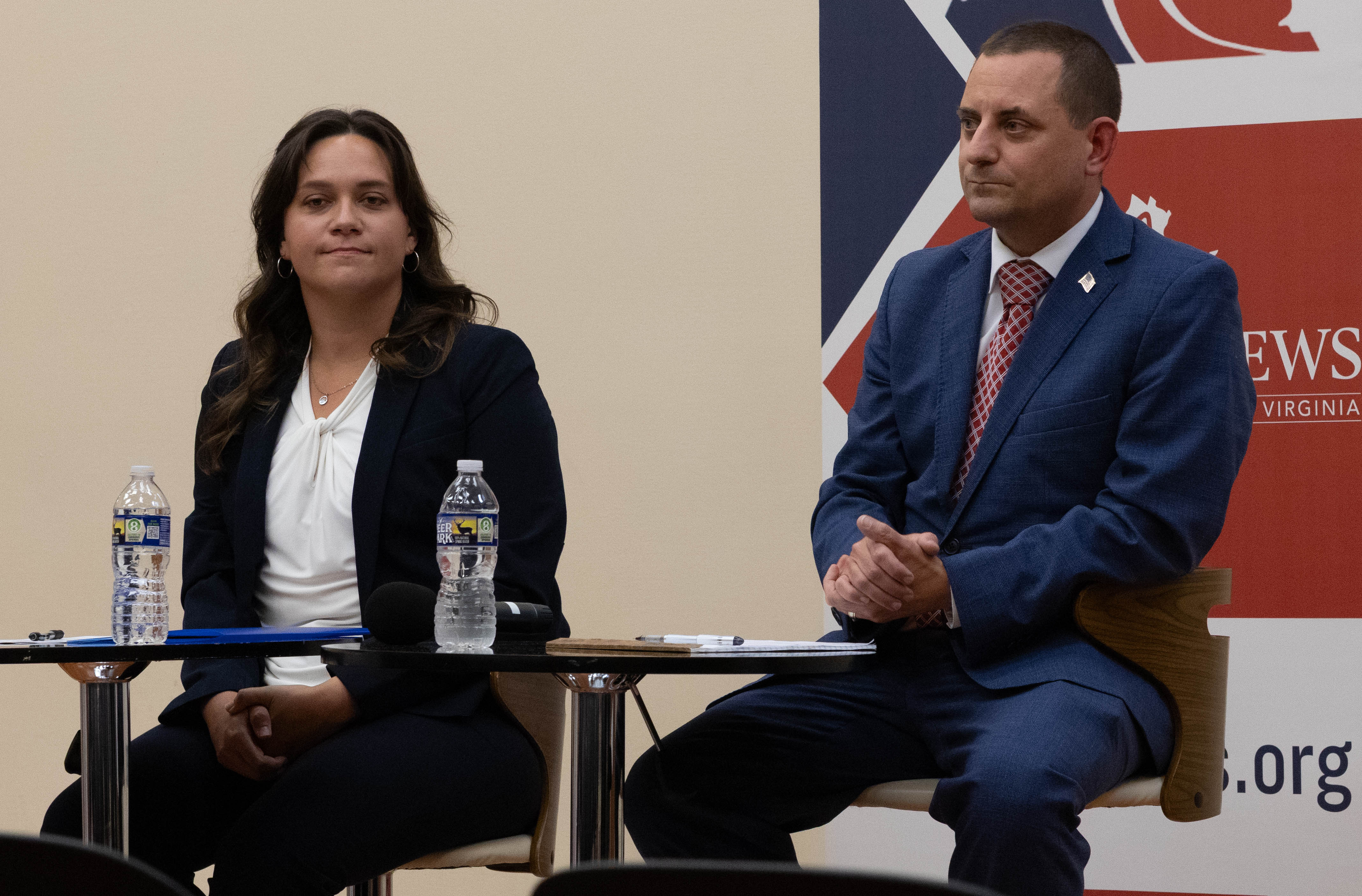
Democratic challenger Lily Franklin and Republican Delegate Chris Obenshain at the Cardinal News candidate forum for the 41st House of Delegates district, Monday, Sept. 15, 2025.
(Jonathan Mususa, The News Feed)
BLACKSBURG, Va. – On Monday, Sept. 15 at 6:30 p.m., Blacksburg residents and potential voters crowded into the meeting room at the Blacksburg Public Library to hear Republican Delegate Chris Obenshain and Democratic challenger Lily Franklin speak at a candidate forum for the 41st House of Delegates district organized by Cardinal News.
Running in a rematch of the 2023 race which saw Obenshain win by 183 votes, the two candidates answered questions submitted by audience members ahead of time in a conversation moderated by Roanoke College political science professor Jeff Vick.
This forum was held as a part of Cardinal News’ “The Cardinal Way: Civility Rules” project, centered on promoting productive discourse across party lines.
Note the word civility. Likely with the bouts of heckling at the Buena Vista Labor Fest and an earlier forum in the 40th House district on her mind, Cardinal News executive director Luanne Rife made things rather clear to the audience.
“The moderator, Jeff Vick, will give a warning if anyone’s out of line and, if there’s a second incident, we’re just going to quit,” Rife said. “We’re going to just close it down.”
“We’re also livestreaming this on our Facebook page and it’ll be archived on YouTube, so that’s another reason you don’t want to be that person or anything.”
Fortunately, things went ahead fairly smoothly.
Virginia Tech and what students want
With Virginia Tech students having broken overwhelmingly for Franklin back in 2023, it perhaps comes as no surprise that her campaign has reached out to students, with Franklin echoing some of the concerns she heard.
“How are we going to make sure young people can afford homes?” she asked the audience. “How are we going to ensure they have access to good jobs that they can grow after they leave the university, that they have internships, and that we’re also protecting their rights?”
Obenshain cited work he had done to benefit the Virginia Tech community – co-sponsoring legislation to improve access to sexual assault response kits and budget amendments for increased funding for the university – before addressing the state of the region’s economy.
“I’ve talked to a lot of folks who have graduated from Virginia Tech and wanted to stay here in the New River Valley, but they couldn’t find a job,” he said. “They couldn’t find the right job for them that would keep them here, and that’s why I think economic development and prosperity is such an important part of what we do in Richmond and in the General Assembly.”
The Virginia Clean Economy Act of 2020 and phasing out fossil fuels by 2050
Franklin staked out a position as “one of the most vocal opponents of the legislation” for its supposed failure to “protect ratepayers” against rising energy prices, the blame for which she placed on, among other things, increasing energy demand from data centers and insufficient regulation of Dominion Energy and Appalachian Power – corporations that Franklin is not accepting campaign contributions from.
“I think, as we head to Richmond, this is going to be the biggest fight in 2026,” she said, referring to debates about the future of the Commonwealth’s electric grid.
In one of the tenser moments of the evening, Obenshain began his response by casting doubts on the nature of Franklin’s opposition to the VCEA, going on to say that she “supports the goals of the VCEA, and it’s the goals of the VCEA that are the problem.”
Obenshain went on to lament increases in electricity rates in the Commonwealth since the VCEA’s passage, as well as Virginia’s status as one of the nation’s top energy importers.
Healing the partisan divide
Drawing upon his work with Democrats on protections against anti-Semitic violence and increased funding for the Marcus alert system for mental health emergencies, Obenshain called for people to “rediscover our sense of civic engagement.”
“Getting off of our phones and getting out into our communities is something that’s going to be really important for us moving forward,” he said, before touching on the recent cellphone bans that have gone into effect in school districts across the Commonwealth.
“Teachers are talking about it being noisy in the lunchroom again. Those are good things and that helps us as a country.”
Franklin confessed to doing more to the end of pursuing unity than many of her fellow Democrats thought prudent, but her work supposedly was not in vain.
“I have had people who voted for Donald Trump, people who are big supporters of Marjorie Taylor Greene, all tell me how they will be supporting me this election,” she said. “And that’s because we’re able to talk about how we have shared community values.”
She also called for a less partisan and more realistic view of the legislative process.
“Almost every piece of legislation that comes out of Richmond – and Chris can attest to this – is bipartisan … When we talk about legislation, we do need to talk about a lot of the things that we’re doing together, because most of it is together.”

Audience members watch as Democratic challenger Lily Franklin responds to a question.
(Jonathan Mususa, The News Feed)
At the evening’s end, Obenshain thanked his family and constituents for their support and touted his accomplishments anew. The impending arrival of passenger rail to Christiansburg, increased funding for education, and Virginia’s nation-leading decline in overdose deaths are, he assured the audience, among the results of “what happens when you put experienced leadership with common-sense solutions.”
Franklin focused more on the difficulties being faced by people of all generations in the 41st and how her background as a working-class native of Southwest Virginia allowed her to relate to them.
“Five generations of my family’s from here, from two all the way to 92,” she said. “So, when I look at policy, I think about how you can thrive at every stage of your life.”
Afterwards, Cardinal News executive editor Jeff Schwaner thanked those in attendance for their cooperation and sent them back out into their communities with the knowledge that “this is the best of politics.”
 > THE NEWS FEED <