
By Elizabeth Hill, education reporter
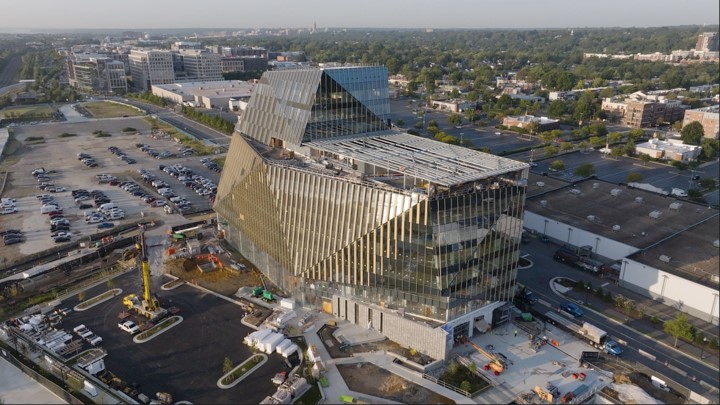
Virginia Tech’s new Innovation Campus, a striking and architecturally bold facility in Alexandria, opens Feb. 28. The cutting-edge campus in Northern Virginia will offer students state-of-the-art amenities to help them thrive in their future careers. The opening marks a transformative moment for the university.
Why it matters: This major investment by Virginia Tech expands the university’s footprint in the greater Washington, D.C. area and reinforces its commitment to serving the Commonwealth. The facility will focus on high-demand fields like computer science and computer engineering, directly addressing the region’s growing need for tech talent, especially with the continued expansion of companies like Amazon’s HQ2.
Located near the soon-to-open Potomac Yard Metro station, the campus offers convenient access for students, faculty and collaborators. Its proximity to major transportation hubs, including Reagan National Airport, further enhances accessibility and strengthens connections between Virginia Tech and the region’s booming tech sector.
Flashback: Construction on Academic Building One, the first building on Virginia Tech’s Innovation One campus, began in September 2021. The 300,000-square-foot, 11-story building was always going to be a major undertaking.
SmithGroup, the architects behind the building’s design, and Whiting-Turner, the construction contractor, are collaborating to bring this complex vision to life. The finished building will showcase their combined creativity, teamwork and expertise.
Virginia Tech News spoke with Sven Shockey, a 1996 alumnus and vice president and design director at SmithGroup, about the project.
- “We all felt this project was ideally suited for us because Virginia Tech set ambitious goals for a building with a high level of sustainability and wanted to house the computer science and computer engineering programs in a top-tier research environment,” Shockey said.
- “The building and site need to function as a self-sufficient mini-campus,” he added. “It must stand on its own for a while until the surrounding buildings are developed,” Shockey added.
Zoom in: The Alexandria campus offers a range of revolutionary features designed to foster a sustainable and educational environment. From energy-generating windows to an indoor drone testing facility, the campus offers unique opportunities for research and collaboration.
- Sunlight powers the building through photovoltaic panels integrated into the south and southeast-facing windows. Unlike traditional rooftop solar installations, these window-mounted panels harness solar energy directly within the building’s facade.
- A two-story, 465-square-foot drone testing cage spans the third and fourth floors. This indoor facility complements the outdoor drone park near the Oak Lane community in Blacksburg, providing Innovation Campus students with year-round access to drone technology.
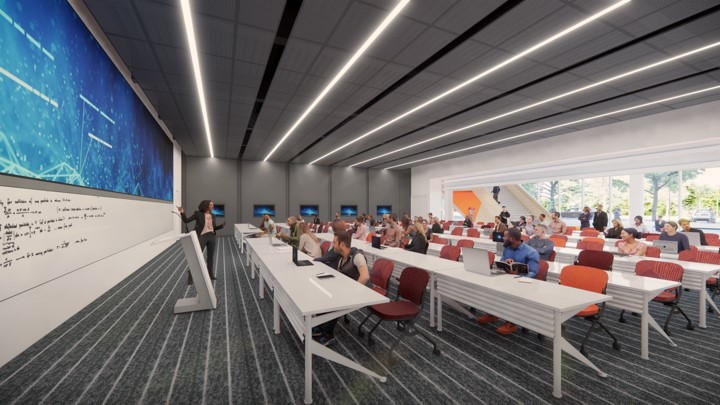
- The spacious 3,000-square-foot Boeing Auditorium, conveniently located adjacent to the two-story lobby, will host lectures and presentations. Naming the auditorium after Boeing recognizes the company’s role as the Innovation Campus’s first foundational partner.
The design also incorporates a touch of Virginia Tech’s Blacksburg roots. While the Blacksburg campus features iconic Hokie Stone, the Alexandria building uses terracotta masonry.
- “We have our Hokie Stone masonry in Blacksburg, and the new building utilizes terracotta masonry,” said Liza Morris, university architect, in an interview with Virginia Tech News. “In this way, we’re still maintaining a textural masonry element. It felt like the right materiality and the right way to honor the legacy of collegiate Gothic stone architecture of our Blacksburg campus, but in a way that’s appropriate for the new context.”
What we’re watching for: The Innovation Campus’s Academic One building opens Feb. 28, marking the start of what promises to be a hub for cutting-edge research and education. The official opening ceremony and ribbon-cutting will commence at 10 a.m. and is an event open to the public.
This is just the first step for the Innovation Campus, which plans to add two more academic buildings to accommodate a growing number of students and faculty.
 > THE NEWS FEED <