

By Zain Omar
The Art, Research, and Technology Exchange (ARTx) was founded in collaboration with Virginia Tech’s Institute for Creativity, Arts and Technology (ICAT) and hosts conferences in specialized performance venues with universities on the advancement of technology’s role in art.
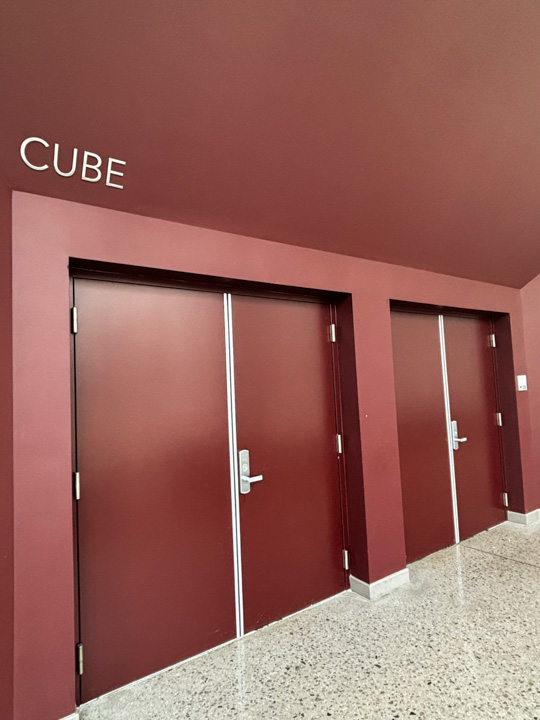
The idea of ARTx came to fruition when Kyle Hutchins, assistant professor of practice at Virginia Tech, played a piece that was composed specifically to be played at the Cube in Moss Arts Center. He realized that certain works could not be duplicated or transferred to digital media because the experience of the performance is affected by the environment.
ARTx allows for professionals and students in the art space to research the impact that advancements in technology affect the way art is shared, learned and taught. Universities and organizations have the opportunity to be awarded grants for their research to keep advancing multimedia performance spaces on their campuses. Virginia Tech was awarded the SEAD grant to fund future projects at the Cube during the spring 2024 ARTx conferences.
ARTx features guest lectures at their event where researchers and art faculty from around the world can share how they found that technology has impacted the learning and performance landscape. Music therapist, Grace Carr, has experienced first-hand how technology has affected the way we learn art. “As a music therapist, I have seen first-hand how teaching music and understanding it have changed because of technology. It is my opinion that technology has allowed for teaching to become much more accessible and readily available to people,” said Carr.
ARTx research focuses on advancements in technology and how they impact the way art is shared, whether in educational environments or in specialized performance venues, such as the Cube. According to Virginia Tech’s Institute for Creativity, Arts and Technology, “The initiative emphasizes collaborations with peer institutions that feature spatial audio and multimedia performance spaces and festivals.”
Advancements in technology also play a role in art classrooms. As new technology is being introduced each year, students and teachers must adapt to new ways to create.
Advancements in technology change the learning landscape for students who are pursuing careers in artistic fields. Former music education student and Music Therapist Grace Carr found that technology has enhanced the learning environment when it comes to artistic fields. “I would say that technology has changed the way we learn art, in that it had simply added on to what we learn. That is not to say that I didn’t learn anything the “old fashioned” way. When I was learning to transcribe music, I would first learn on paper, then on a computer software. So, I would say that in leaning art, technology can help us enhance what we already know,” said Carr.
With the rise of art created for specialized research environments, institutions have found that sharing their work in other settings can be difficult. “When institutions have highly specialized research spaces for art-making, sharing work with other institutions can become challenging, if not impossible,” according to ICAT. ARTx is a way for these institutions to team up to find ways to develop these works to be shared in other space.
Through ARTx, researchers are finding ways to better be able to share these works that have been composed to fit only certain environments. This research will open doors or new ideas and innovative ways that art can be created.
ICAT hosts collaborations with festivals, universities, and organizations throughout the year. They have currently teamed up with 11 partners with locations all around the world. Currently, ARTx has partners in Canada, California, Ireland, New York, and Washington, D.C.
Virginia Tech hosts the New Music and Technology Festival every two years, where faculty and researchers apart from ARTx convene to share their research through lectures, performances and installations. The festival also features student works and is an environment for art and technology disciplines to learn and collaborate with each other. According to ICAT, “the festival highlights diverse disciplines, including music, theatre, cinema, dance, visual art, creative coding, computer science, neuroscience, molecular biology, robotics, and cybersecurity.”
Events for this festival are held in specialized research and performance spaces around Virginia Tech’s campus, such as the Cube, the Sandbox, and Perform Studio.
When Virginia Tech is not hosting the organizations that are part of ARTx, faculty is sent to attend conferences all over the world hosted by other institutions in the art exchange. The most recent conference that Virginia Tech attended was a five-day conference at the Center for Interdisciplinary Research in Music Media and Technology in Montreal, Canada.
Through the collaboration with ARTx and ICAT, along with the other universities and organizations that have joined the art exchange, new understandings of the way technology and art intertwine will start to change the way we share and view art.
 > THE NEWS FEED <