
As empty classrooms fill up after a lonely summer, there’s a small chorus of keyboard clicking, backpack zipping, and chatter among eager students as a hopeful year begins. But that back-to-school melody is paired with the disgruntled harmony of coughing, sneezing and whatever sound that kid behind you is making who you swear is hacking up a lung.
At Virginia Tech, we call it the Hokie Plague. It’s a sinister sickness that hits almost every student at some point in the first month of the semester and drives a motivation to make it to class every day to a moment of I can’t leave my bed, I feel horrible! But this “Hokie Plague” isn’t new to Blacksburg, and like many seniors, it isn’t hoping to leave campus anytime soon.
“Definitely heard that over many years,” joked Monica Martin, the Health Quality Manager at Schiffert Health Center at Virginia Tech. “It’s sort of a love-hate relationship. Because we get that students are like, ‘Oh, it’s the Hokie Plague,’ but we also want them to understand it’s not just one thing that’s going around getting everybody, it’s a number of viruses.”
So, there you have it – As much as we all would love to see the “Hokie Plague” listed in the Center for Disease Control as one of the deathliest illnesses (Because, at the moment, it really feels deathly,) it isn’t just one thing. It is not just Virginia Tech that battles an illness at the beginning of each year. Talk to anyone on a college campus, and they’ll tell you the witty name they use for the campus-wide sickness – Like James Madison’s “JMFlu,” Penn State’s “PSFlu” and Virginia Military Institute’s “Barracks Plague.”
If you were hoping for a diagnosis, CareSpot Urgent Care identifies the most common college illnesses as the flu, upper respiratory infections (“illnesses that leave you hacking, coughing and just feeling miserable”), mononucleosis (mono), and stomach bugs.
And let’s not forget that pesky pandemic that banned us from the classrooms for nearly a year. Although many people have gotten their vaccines, Coronavirus is still on the loose, hoping to latch onto anyone.
“I know across the country there was some spikes at the end of summer, so I’m sure there is some circulating,” said Martin. She’s not wrong – The Virginia Department of Health reports that 0.56% of all emergency visits resulted in COVID-19 diagnoses in the first week of April this year. Four months later, in the first week of August, that rate was 2.78%. The highest rate in August for diagnoses was in the third week of August, where it was 3.24%… Right around the same time students are coming back to school.
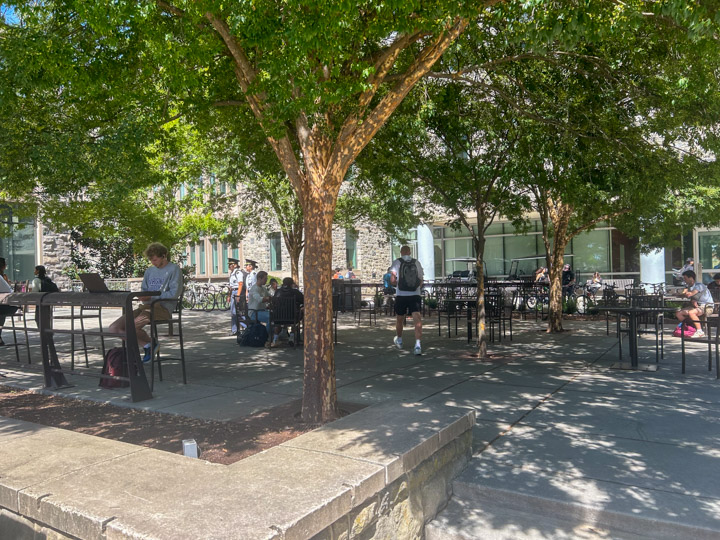
Students gathered outside Lavery Hall during the first week of school.
“You have thousands of individuals coming into a very concentrated area in a short period of time. And so as everybody convenes back on campus, they bring with them any germs, bacteria and viruses that they may be carrying with them, and that are just in our environment in general,” said Martin. “If you think of it as like a pool, it’s an empty pool. And then you throw everybody into this pool, everybody’s going to get exposed at some point. And depending on what bacteria or viruses that [are] in our community, they kind of have different rates of how they spread and how infectious they are.”
The entire campus is that pool, and it makes it extremely difficult to avoid getting sick between dining halls, football games, dorm buildings, and downtown life. Luckily, Martin said that within the first week of school, the health center wasn’t seeing too many people coming in feeling sick.
“I think last week wasn’t terribly bad,” she said. “That’s also just the first-time students getting together. So it will take time for those all to spread and then people to develop symptoms. I think we’re starting to see some of that now after the long weekend, and individuals have been gathering together and those symptoms are now trying to show after two or three days.”
Although the possibility of sicknesses getting worse as the beginning of the semester progresses, Martin said there are steps students can take to prevent catching the “Hokie Plague.”
“The first thing I would make sure students know, and it’s the hardest one I know for folks, is if you’re sick and feeling sick you should try to stay away from others and stay away from crowds,” said Martin. “Because you are going to be the infectious person who’s spreading it around to everyone else, and that’s where it will start.”
Martin recommends that if you’re feeling that tickle in your throat or a bit of a sniffle to always mask up. Schiffert Health Center has masks available to students in the lobby and Martin said staff would be more than happy to give students any available masks if they want to stay safe.

Masks available to students at the entrance of Schiffert Health Center.
“The second one is washing hands,” continued Martin. “Obviously, it’s been drilled into us since COVID. Wash your hands, wash your hands. So that really is important, whether you’re the ill person or if you’re a well person and you are just trying to prevent getting sick.”
Even if you take every precaution possible to avoid catching the Hokie Plague, sometimes it’s inevitable. But Martin wants to assure all students that Schiffert Health Center is right on campus and willing to help if they feel themselves starting to get sick.
“If it’s the middle of the night and you’re starting to feel sick, you can make an appointment in the evening time and then there’s usually appointments the next day,” said Martin. She encourages students to schedule appointments online at the Healthy Hokies Portal. “If students are really feeling awful and ill and they have concerns that’s like ‘This feels more than just a cough or cold,’ they can call us to talk to a triage nurse and try to get in earlier if they feel like it’s urgent,” she added.
So, whatever you do this semester – Don’t be the person hacking up a lung behind someone in class. But resources are available if you find yourself coming down with the Hokie Plague.
 > THE NEWS FEED <