By Isabella Ubillus, crime, safety, and justice reporter
Opioid overdoses continue to impact communities across Southwest Virginia, with first responders responding to these emergencies on a regular basis. Narcan, a medication that can reverse the effects of an opioid overdose, plays a critical role in those first few minutes before paramedics arrive. Rescue squads say increasing awareness and education around Narcan could help save more lives.
By Isabella Ubillus, crime, safety, and justice reporter
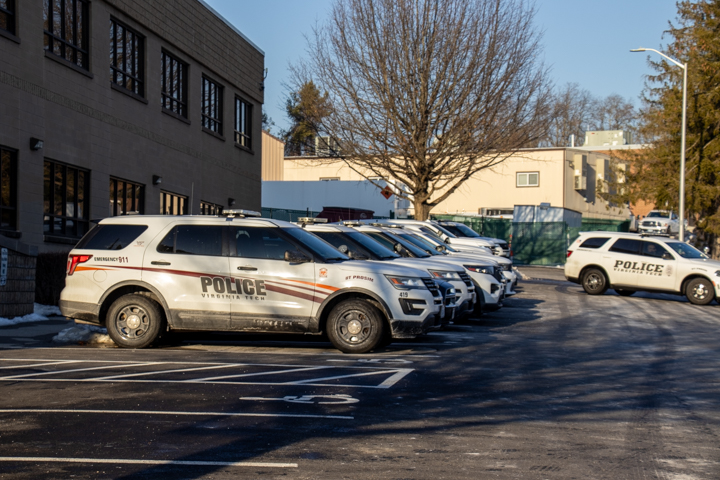
Virginia Tech police vehicles sit outside the department headquarters in Blacksburg, Va., Tuesday, Feb. 10, 2025(Isabella Ubillus, TheNewsFeedNRV)
On any given night in Blacksburg, encountering an impaired driver remains higher than people might think. The issue continues to challenge police and public health officials alike.
Virginia Tech Police made 53 DUI related arrests in 2025, an increase from 47 in 2024. While the statistics may tend to fluctuate, law enforcement says that the risk still remains.
“Really any night that the bar is open, the possibility of arresting a DUI driver is very high because of the environment,” Lt. David Tribble of Virginia Tech Police said.
In the New River Valley, and Blacksburg specifically, impaired driving is not only a criminal offense, but a broader public safety and community issue. Local law enforcement, behavioral health officials and researchers all say that the American drinking culture, the emerging use of cannabis and a shift in social perception continue to shape the DUI risks in college towns and in the rural region of the New River Valley.
Many of the recent arrests made are due to the growing officer experience, according to Tribble.
“Some of our officers are getting into their years of experience and they’re able to see the signs of impairment better…with more experience, they’ve been able to make more arrests,” Tribble said.
For many college aged students, the signs of impairment may not be as obvious.
“When they come to college, they experiment a lot and they don’t have a lot of experience with alcohol, so they end up drinking more than they should and they don’t really have the foresight to know that it’s unsafe,” Tribble said. “They think that they’re fine, kind of that mentality of being young and invincible.”
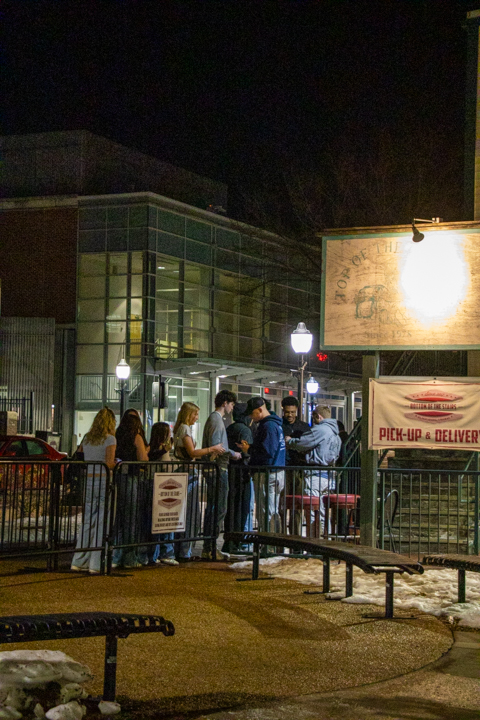
Students enter Top of the Stairs, a local bar, in Blacksburg, Va., Tuesday, Feb. 10, 2025. (Isabella Ubillus, TheNewsFeedNRV)
Early on in his career, Tribble worked fatal crash reconstruction with his unit, many of which were fatal crashes involving alcohol.
“The possibility of altering your life permanently or somebody else’s life…taking that risk of driving after you’ve consumed alcohol is not worth that possibility,” he said.
But the consequences reach beyond the individual driver.
“It absolutely is a community issue,” Wade said. “Law enforcement comes into play after someone participates in that behavior. From a community standpoint, we have to reiterate the point that this is not socially acceptable.”
New River Valley Community Services is the region’s primary provider of behavioral health services and serves around 12,000 residents annually across Montgomery, Floyd, Giles and Pulaski counties along with the city of Radford. According to Wade, DUI related crashes can severely impact communities beyond the legal proceedings.
“That’s a life-changing event for a family to go through, and that adds a layer on top of normal grief that folks might feel,” Wade said. “It impacts the entire community when we lose someone to a senseless mistake like that. We all suffer for that in some way, whether we know the person directly or not.”
Simultaneously, substance use trends are shifting. Cannabis use is becoming more common, particularly with conversations about the drug becoming legalized for recreational use in Virginia.
“I think society has beaten the drum pretty well when it comes to not drinking and driving,” Wade said. “We’ve already seen some early data that indicates people who regularly use THC products tend to get behind the wheel more than they should. If you’re going to use this stuff, do it wisely and be responsible.”
Research done by the Virginia Tech Transportation Institute (VTTI) supports those concerns. According to Naomi Dunn, a research scientist at VTTI, a third of fatalities on roadways are due to impaired driving — around 13,000 deaths every year.
Dunn’s research focuses on how to refine in-vehicle technologies to help prevent impaired driving. In recent studies, participants were dosed with controlled amounts of alcohol looking at various driving performance measures.
“Alcohol is very much a linear relationship between the amount of alcohol you consume and the impact that it has on your performance,” Dunn said. “The more you consume, the worse your driving gets. Without a doubt.”
Impairment due to cannabis presents its own challenges. Different methods of consumption can affect users in different ways.
“We see that people have a tendency to react slower when they’ve consumed cannabis,” Dunn said. “They brake later and harder, because they’re not focused on what they’re supposed to be doing.”
She also warned against the rising issue of polydrug use, the mixing of different substances. Citing that smaller amounts of each substance has a larger impact than on their own.
For many students in a rural region like the New River Valley, isolation and social acceptance play a role in these decisions. Many high school students in the area cite the fact that there are not enough extracurricular activities, leaving them to drink with their friends, according to Wade.
“There’s a low perception of harm from a society standpoint,” he said. “We have seen the glorification of marijuana, guys like Snoop Dogg openly promoting the use of those kinds of products. Alcohol is more socially accepted than it was 20 years ago.”
Different prevention strategies have been proven effective, education and proper messaging being the most critical, according to Dunn. For first time offenders, putting them in treatment programs and installing interlock devices can be more effective than license suspension.
“You can teach people a lesson without actually destroying their life, if that makes sense,” she said. “For younger people or for first-time offenders, it’s better to try and delay those harsh, punitive punishment options and try a treatment approach first.”
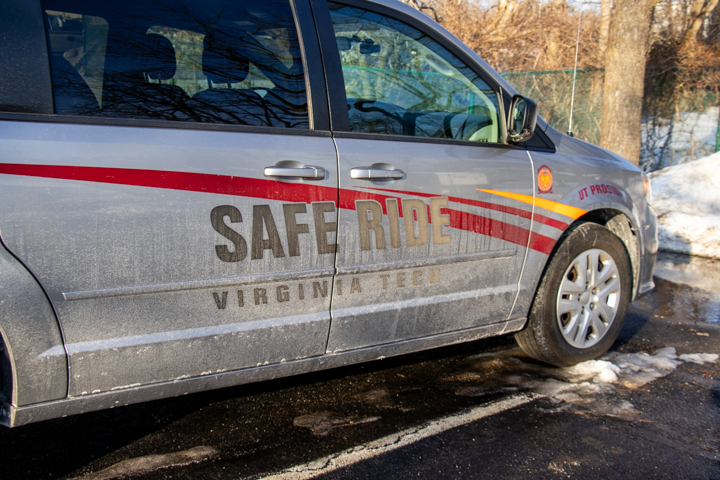
A Virginia Tech Safe Ride vehicle is parked on campus in Blacksburg, Va., Tuesday, Feb. 10, 2025 (Isabella Ubillus, TheNewsFeedNRV)
In Blacksburg, transportation alternatives such as Safe Ride, rideshare services and public transit are available.
“I don’t think it comes down to shame and stigma,” Wade said. “I think you need to be clear about the potential risks and the harms that people could face for themselves or for others that might be involved. And really just ask them to make responsible, educated decisions that aren’t just about them, but the people around them.”
By Isabella Ubillus, crime, safety, and justice reporter
Annie Chalmers-Williams poses for a headshot. (Courtesy Virginia Tech)
As the spring semester begins for Virginia Tech students, so does a familiar part of campus life, the party scene. For Hokie Wellness, their goal is to teach students safer ways to celebrate and still stay in control.
Virginia Tech’s Hokie Wellness has become a central hub for substance misuse prevention on campus. Annie Chalmers-Williams, Assistant Director for Substance Misuse Prevention, oversees programs that combine education, peer support and hands-on training to guide students in making safer decisions.
Since joining Hokie Wellness in 2020, Chalmers-Williams has brought over a decade of experience in clinical social work and substance use treatment, including working with the Eastern Band of Cherokee Indians and youth aged 6 to 18 with the Juvenile Justice Treatment Continuum.
Her role focuses on all things prevention related to substance use as well as managing the IMPACT team, which facilitate workshops such as Party Positive for alcohol harm reduction, Higher Education for cannabis education and safety and REVIVE! for opioid overdose response training. Beyond managing the IMPACT team, she also manages the BASICS program, offering early educational interventions for students with infractions related to substance use aimed to provide a supportive environment rather than punishing students.
In an interview, Chalmers-Williams discussed how Hokie Wellness defines “safer partying”, trends she sees among students and the resources available on and off campus.
Her comments have been slightly edited for length and clarity.
How do you define safe partying at Virginia Tech?
The first thing we talk about is that we can’t ever stay safe, we have to stay safer. We emphasize harm reduction, thinking about ways to make things safer.
Hokie Wellness teaches six main strategies: choosing if and when you are going to drink, pacing, hydration, tracking your drinks, eating properly and having a safe ride home.
Education about binge drinking and alcohol poisoning is also key. One of my favorite things to teach is the “Party Positive Zone”, which is an optimal blood alcohol concentration (BAC) between 0.00 and 0.06. We tell people that if they are going to party, we want you to party in that zone because you’re more likely to experience the euphoria that comes with alcohol without the negative side effects.
We have a Party Positive card that estimates the number of standard drinks to keep someone in that zone based on sex, body weight and time spent partying. We want to try to keep people from having negative experiences.
What are the biggest alcohol related problems that you see among students? Is there a difference between the beginning of the semester versus the end?
Our culture is steeped into alcohol, especially among college students. We’ve seen a rise in drinking and driving and DUIs. Binge drinking continues to be an issue. Health wise, drinking 10 drinks in one night is more harmful on your body and brain than drinking moderately throughout the week.
In the fall semester, we see younger students getting involved with substances as a way to connect socially, leading to early-on alcohol infractions, specifically in the dorms. By the end of the year, due to graduation, we see these similar situations with our students who are of an older age.
Are there additional steps that Hokie Wellness takes around big events, like football games or graduation?
Hokie Wellness tries to plan for that. We have our social media accounts pushing public health information and outreach on how to party safely. Hokie Wellness is part of the recovery community, and they have sober tailgates for students who want to enjoy the game day atmosphere without alcohol or other substances.
At the beginning of the school year, we do a lot of work during those weeks of welcome as well as having programming at GobblerFest. It’s about getting ahead and encouraging people to come and pay attention. We are aware of those higher risks and a goal we always have is to work harder to remind students to think about their safety and their futures.
What steps can students take to drink more responsibly?
The biggest thing is learning about it so that if you choose to drink, you know what you’re doing, because a lot of people don’t know what they’re doing. Have strategies to protect yourself. Start your night out early, hydrate, eat a good meal, count your drinks, pace yourself and make sure you have a safe ride home, that’s going to protect you. Learn all about it so that you’re in charge, not your friends or the alcohol, you.
How does Hokie Wellness address consent when it comes to party environments?
We do a lot of education on what consent means and teaching people when alcohol is present, most of the time, consent is not a thing you can do. We partner really closely with sexual violence prevention staff to get on the same page. When working with fraternities and sororities, we always embed consent in there, it’s in everything but we do more of a discussion then.
Besides alcohol, what other substance trends should students be aware of?
We do a lot of cannabis education because Virginia has only decriminalized it, but people think it’s legal. It puts them at risk for unhealthy use or legal risk. We spend time teaching people about the laws, so they can make good choices for themselves.
Through REVIVE!, we discuss opioids and the most common way that students are experiencing overdoses is through counterfeit pills. Cocaine is included in those conversations due to its risk of contamination.
Tobacco and nicotine support is currently in production. Right now, we do one-on-one sessions with students and referrals to Schiffert Health Center for medical and behavioral support.
What other resources are available for students that they might not be aware of?
We have useful links and resources on the Hokie Wellness website, making it a good first resource. On campus, Schiffert Health Center, Cook Counseling, TimelyCare and the recovery community offer both medical and mental health support. National resources such as SAMHSA, NIDA and RAINN provide additional help.
Our health department can help students get connected with resources such as free testing strips and Narcan. Rec Sports is also great, getting involved in physical activity can help with withdrawal as your body heals. Exercise is the way to build that capacity for your brain to start creating dopamine again.
If you could give students one piece of advice, what would it be?
A good simple strategy would be that you should not have more than one drink per hour. Pacing wise, that is probably the easiest thing to remember and the best way to pace. That would be my advice right now, stick to one drink an hour or less.


 > THE NEWS FEED <