
By: Josie Sellers, health and wellness reporter
BLACKSBURG, Va.- Registration remains open for the next two to three weeks for Virginia Tech’s Rape Aggression Defense (R.A.D.) System program, a national course designed to teach males and females how to defend themselves in emergencies.
Offered by the Virginia Tech Police Department, the program consists of four classes throughout the semester. Registration remains available until the day before each session begins or until the class reaches its maximum capacity of about 50 participants.
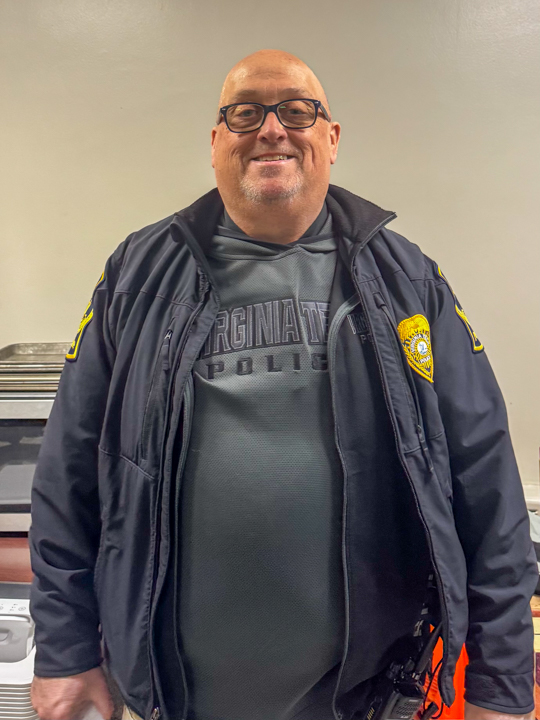
I spoke with VTPD Cpl. John Tarter about the program’s purpose, format and background.
His responses have been slightly edited for clarity and conciseness.
Can you please give me a background on the program and what it is designed to do?
It was started by a police officer. He’d been in the Marine Corps. He was into martial arts, and he went to the police academy in Hampton, Virginia. Then he ended up going to Christopher Newport as a cop.
He went to one of his police chiefs and said, “Hey, can you come up with a basic self-defense class for women?”
And he started one. He got cops because he taught cops how to do defensive tactics at the police academy. Then he got other cops that taught defensive tactics to help him teach the R.A.D. program. And so, it’s spread. It’s not everywhere in the country, but a lot of colleges, universities and police departments have it.
It is four nights. It’s nine hours or 12 hours. The first night is in the classroom: how to stay safe on and off campus. The next two nights are punching: how to get out of chokes, how to get out if they grab your wrists and how to get out of that ground defense. Then the last night we do is each session is called simulation night, but I call it “Fight Night.”
And so basically, you put on a red suit and we put you through two or three scenarios. Most sexual assaults occur between people that know each other. We can’t simulate that. So, we simulate stranger-type situations. Somebody grabs you by the wrist and pulls you- how you can get away from that kind of thing.
Each night is three hours, and we do ours, say, four Mondays in a row. The next time, we’ll do four Thursdays in a row. It empowers a lot of people.
I can’t tell you when to defend yourself, and when not to defend yourself. That’s what the individual has to make the decision to do.
Can you please explain a typical class from start to finish?
On the first night, we meet at the police department. We go over the paperwork, review the manual, do a PowerPoint and talk about safety topics—like what to do if someone is following you home, whether it’s to your apartment or your house. We discuss where to keep a spare key, how to lock your windows and general safety tips for the public.
On the second night, like I said, we focus on upper-body techniques. We practice strikes, punches and blocks. We cover what to do if someone grabs you by the wrist and how to get out of it.
On the third night, we work on ground defense. If you get knocked down, we teach you how to get back up. We show you how to kick from the ground and what to do if you’re on your back and someone gets on top of you—how to throw them off. The instructors demonstrate these techniques on each other, but no one ever gets on top of the students.
We also teach how to escape choking from the front and from the back. I always tell participants that they don’t have to do anything they’re uncomfortable with. They are in control of what they choose to practice.
I explain that they’ll partner up with someone who will gently place their hands around their neck so they can safely practice escaping. But if someone is a survivor of choking and finds that triggering, I tell them not to do it. They can watch and learn instead. No one is forced to participate in anything.
I noticed you offer a men’s and women’s program. What is the difference between the two?
If you decide to defend yourself, we try to amp you up, right? The men’s program, we try to amp them down. We try to deescalate. Because, you know, a lot of times guys are like, “I don’t need no self-defense class. I can take care of myself” and puff out their chests.
Well, that’s what Sergeant Michael Pascal also teaches the police officers: how to deescalate situations like on traffic stops and things like that. So, for me that is the big difference. One is if you decide to defend yourself, we try to amp you up a little bit. And then, if you’re in the men’s program, we try to deescalate them or amp them down.
How do you deal with those who may find the program triggering?
We’ve had people that have been triggered, like when we do the simulations and Fight Night. I’ll never forget, we were in our Dietrich police office, and this young lady came in. She had the fight suit on, and we put her through a scenario.
After she fought—she did well—I said, “Go over there in the corner. Take your helmet off so you can rest. We’re going to go through this first scenario, and then we’re going to put you through a second scenario.”
She went over and sat down, watching the next person come in. She became very upset. She started crying and yelling, saying, “You’re teaching these people wrong. It’s not some stranger at a bus stop—it’s somebody you know.”
Was she right? Absolutely. The vast majority of the time, it is somebody you know. So, she was triggered by that situation. When the next person came in and went through it, she was triggered again as well.
We’ve never had two back-to-back cases where you could tell someone was triggered by the situation. Both of them, we got counseling. We offered them counseling, came out and talked to them, and then they came back and they continued the fighting part. We didn’t make them, but they finished it.
So, in a class, I don’t know who is going to be a survivor of a sexual assault. In that class, there’s probably going to be at least one person that has experienced something in their life. And if we know they’re triggered, we get them resources.
If we don’t know, we still push resources. Now I can’t go ask them, obviously, but over the years, we have had people come forward to us. And we tell them at the beginning of class, “We’re mandated reporters.” So you can’t come up to me and say, “Hey, can I tell you something? But I don’t want to tell anybody else.” That’s not the way it works as far as mandated reporters go, because you have to report it to make a police report.
 > THE NEWS FEED <