
By: Zain Omar, arts & culture reporter
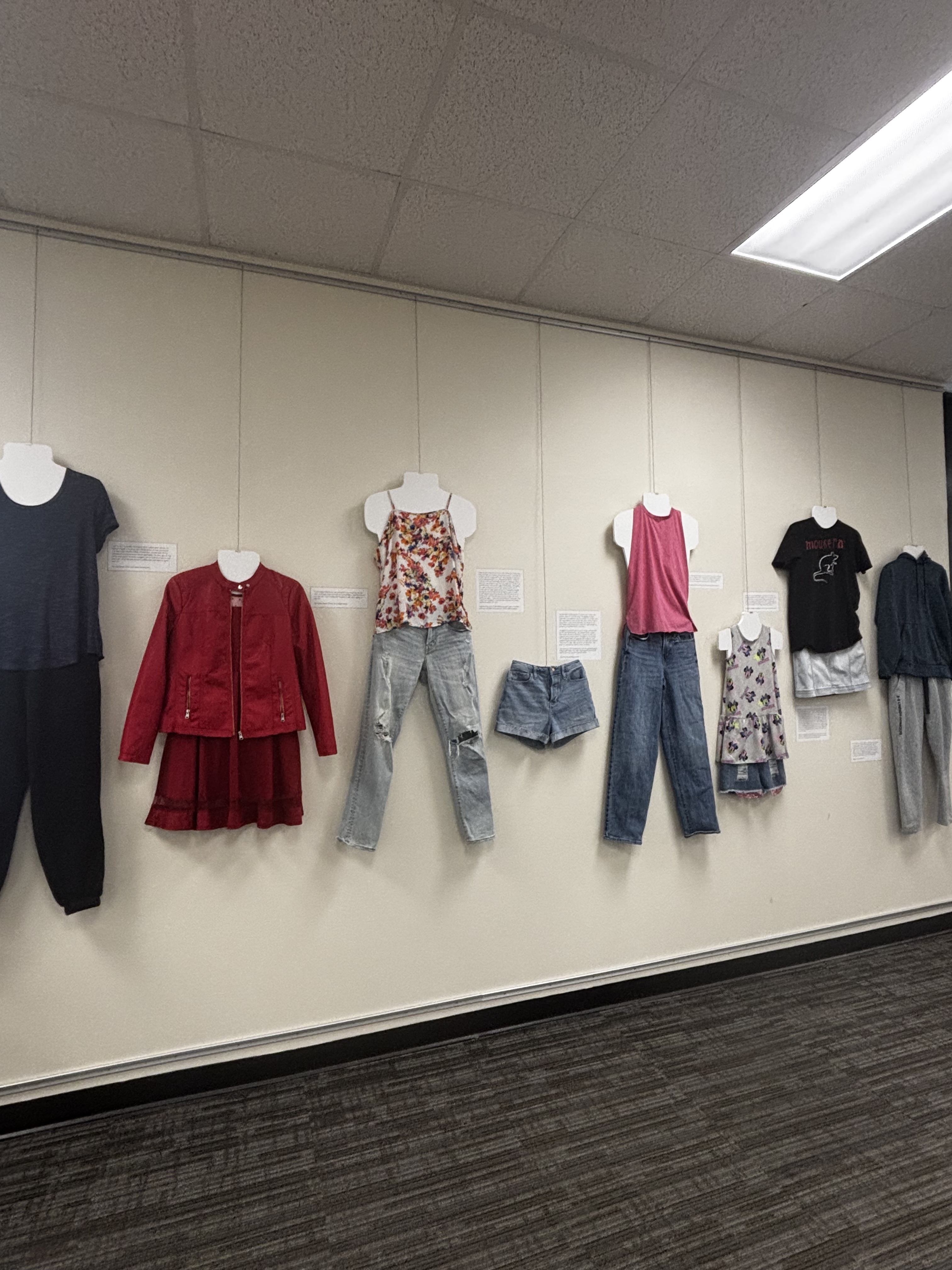
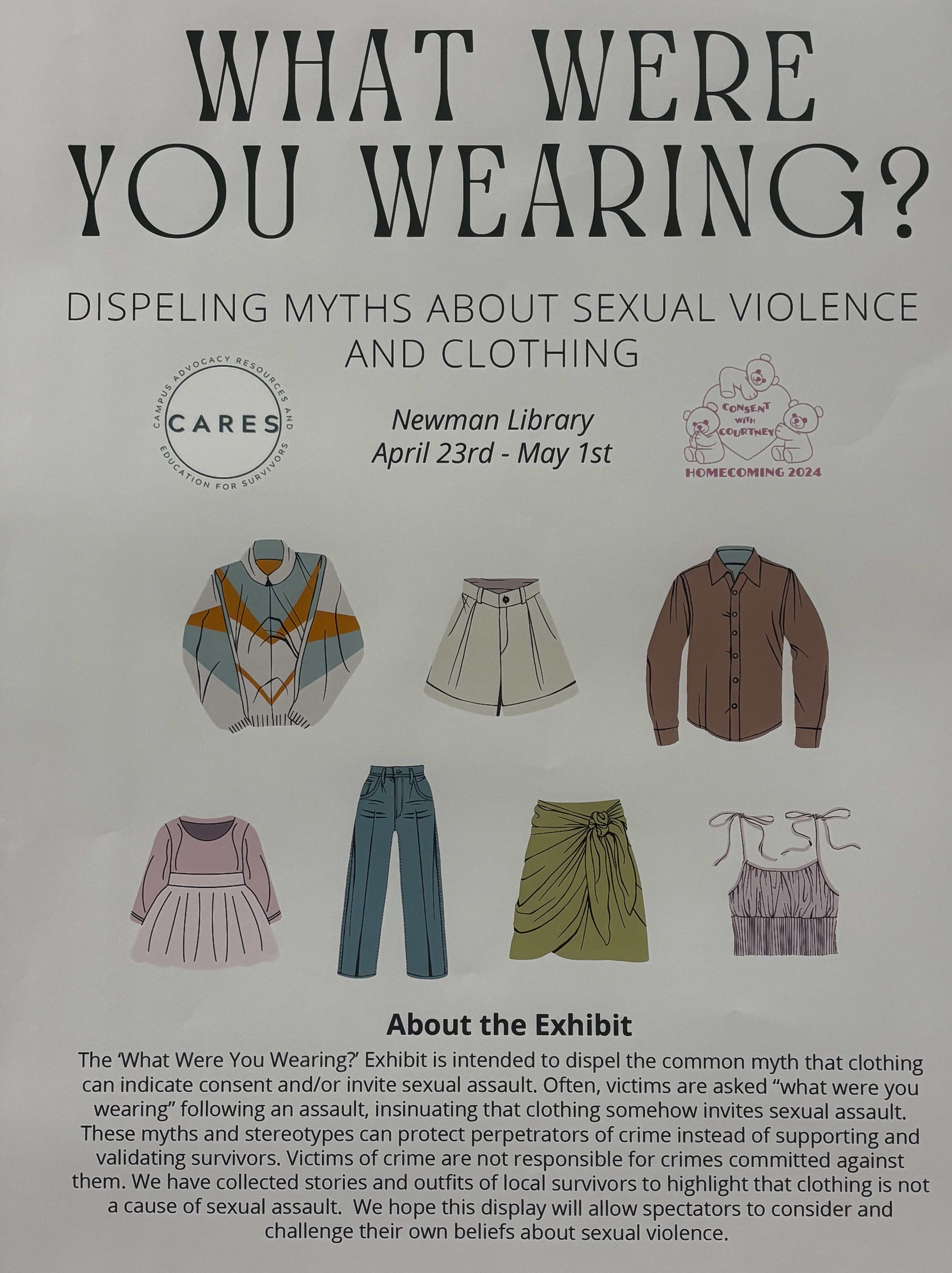
In collaboration with the Women’s Center at Virginia Tech, graduating senior Courtney Bergeron, debuted an installation titled “What We Were Wearing”. The exhibit was part of Bergeron’s homecoming platform, Consent with Courtney, and was on display in Newman Library from April 21st until May 1st.
The exhibit showcased clothing that local victims were wearing when they became a victim to sexual assault. The purpose of the exhibit is to challenge thoughts that what a person is wearing is equivalent to consent. The clothing in the exhibit represents a range of ages and genders, showing exactly what the person was wearing when the act happened.
Bergeron’s personal experience with sexual assault was the main motivator to start Consent with Courtney. “As a victim of sexual assault, I made it my mission to help others just like me. I faced a lot of challenges when going through the medical and legal process and most of it was from lack of knowledge. I knew if I could have a platform, I could spread information I wish I had,” Bergeron said.
After Bergeron’s own sexual assault case was dismissed, she decided she wanted to make a change. Bergeron shared her story on the Consent with Courtney Instagram to show others they were not alone and to better educate everyone on the subject. She became a victim to sexual assault her freshman year at Virginia Tech and the Women’s Center was one of the main advocacy sources Bergeron worked with.
In a statement on Consent with Courtney’s official account, Bergeron stated, “Instead of harboring anger for my situation, I took that hate and turned it into passion to help others just like me. I never want anyone to go through what I went through.”
“What Were You Wearing” exhibits have gained popularity worldwide. With a rise in activism against sexual violence and campaigning to give voices to all victims of sexual assault, exhibits dismantling the stigma against sexual assault have become an international trend.
The What Were You Wearing exhibit was first conceptualized when The Director of The Sexual Assault Prevention and Education Center at the University of Kansas, Jen Brockman and Dr. Mary A. Wyandt-Hiebert from the University of Arkansas Rape Education Center, attended a reading of Dr. Mary Simmerling’s poem “What I Was Wearing”. The poem touches on Simmerling’s feelings of dealing with the aftermath of sexual assault and having everyone ask her about the outfit she was wearing, as if that caused it.
According to the Sexual Assault Prevention and Education Center at the University of Kansas, “Dr. Wyandt-Hiebert and Ms. Brockman wanted to create a project that would place the work of bearing witness to this question’s answer back on the shoulders of the community and humanize the survivor in the answer. To ask the question, ‘what were you wearing?’ cost the questioner nothing, there is no labor in making this statement. However, the survivor must pay dearly in not only their answer but also, in the burden of self-blame.”
One of the largest exhibits of this kind was held by the United Nations. The exhibit originally had 5 outfits, each representing a different region in the world. By July 2022, the exhibit grew to feature 103 outfits. These outfits represent the 1.3 billion sexual assault survivors worldwide.
The United Nations exhibit had many celebrities, business leaders, and influential figures from around the world sharing their stories of sexual assault. The United Nations exhibit put the issue on a grand scale to show no matter where you are from or what you are wearing, the fault is not with the victim.
The exhibit is meant to show that clothing does not offer consent or permission. Sexual assault can happen in any outfit, at any age, and any place. These exhibits ensure survivors that what they were wearing is not what caused their assault, it was the person who committed the act.
“It’s not the clothing that causes sexual violence; it’s the person who causes harm. Being able to find that peace for survivors and that moment of awareness for communities is the real motivation behind the project,” stated Brockman in an interview with Huff Post.
Courtney not only wants to help provide a platform for survivors but also educate everyone on the concept of victim blaming, especially around sexual assault.
“I hope they see that sexual assault can happen to anyone at any time. Clothing is not consent. It does not determine your safety or your worth. The only way to end this horrible issue is to come together as community, educate ourselves, and support survivors,” Bergeron said.
The Women’s Center at Virginia Tech provides advocacy and care to women facing any issue related to sex or gender. The CARES program has a direct focus on advocacy to victims of sexual assault and other forms of harm.
“CARES stands for campus advocacy, resources and education for survivors, so our primary objective is to just provide support and advocacy to students, faculty and staff of all gender identities that have experienced any kind of sexual violence, domestic violence, stalking or harassment. We do that primarily through advocacy-based counseling, we also do a lot of resource recommendations and accompaniments. For example, some of the resources that are available for students is the Title IX office and the Virginia Tech Police Department or the Blacksburg PD. With accompaniments, what that means is we can go with students or faculty who are making reports or meeting with Title IX or the police to kind of act as a third-party, emotional support person, so they don’t have to go through the process alone,” said Bailey Williams, Advocacy Coordinator for CARES.
The Women’s Center also has resources for students and faculty to better educate themselves on sexual and domestic violence. They host events and give presentations to classes and organizations to help them learn more about the Women’s Center and how to get more involved. The Women’s Center also has a webpage where they have all the advocacy resources that they provide listed.
Bailey Williams said, “Obviously doing the research is always a big part of that, taking the time to really understand what consent is, why sexual violence occurs, there’s a lot of really great research and literature out there. Coming to events hosted by the resources that are designed to aid students following an assault is also a big one, we do a lot of tabling and outreach events. Organizations and classes can also request presentations from us. Keeping an eye out for what the resources have available and take the time to do outside research.”
The community of Blacksburg saw the exhibit as a source of comfort and solace, especially those who are victims of sexual assault. Students and other community members felt welcome to share their stories and open about their own experiences.
“I received several messages from survivors and families of survivors reaching out and thanking me for speaking out on this sensitive topic. There is such a stigma around sexual assault and people are scared to talk about it. I am continuously trying to break the stigma. Having the people of this community reach out and let me know that I was helping them was genuinely so rewarding. I said when I started this all if I helped just one person this would all be worth it, and I feel like I really achieved that goal,” Bergeron said.
Bergeron hopes to continue making a difference with her platform after graduation. While she will no longer be in Blacksburg, the Women’s Center at Virginia Tech hopes to keep the legacy going.
“Unfortunately, I will be graduating, so I will be continuing my fight in Northern Virginia. However, we raised over $1000 for the Women’s Center to continue their support of sexual assault victims and educating the community. They hope to make this an annual event,” Bergeron said.
While Bergeron will not be in Blacksburg to continue her platform in the future, the Women’s Center is hoping to keep educating students. The Women’s Center is available to any students and community members looking to learn more or find support regarding sexual assault.
 > THE NEWS FEED <