Transgender healthcare faces increasing challenges from the Trump administration
by Evvy Fite, health and wellness reporter
Amid the wave of conservatism currently present in the United States, one major focus of the Trump administration has been to restrict freedoms and limit access to gender-affirming healthcare for transgender Americans. Between executive orders, rising sentiments of hate, and doctors refusing to accept new patients for transgender healthcare, many U.S. citizens are scared for their rights, their safety and their lives.
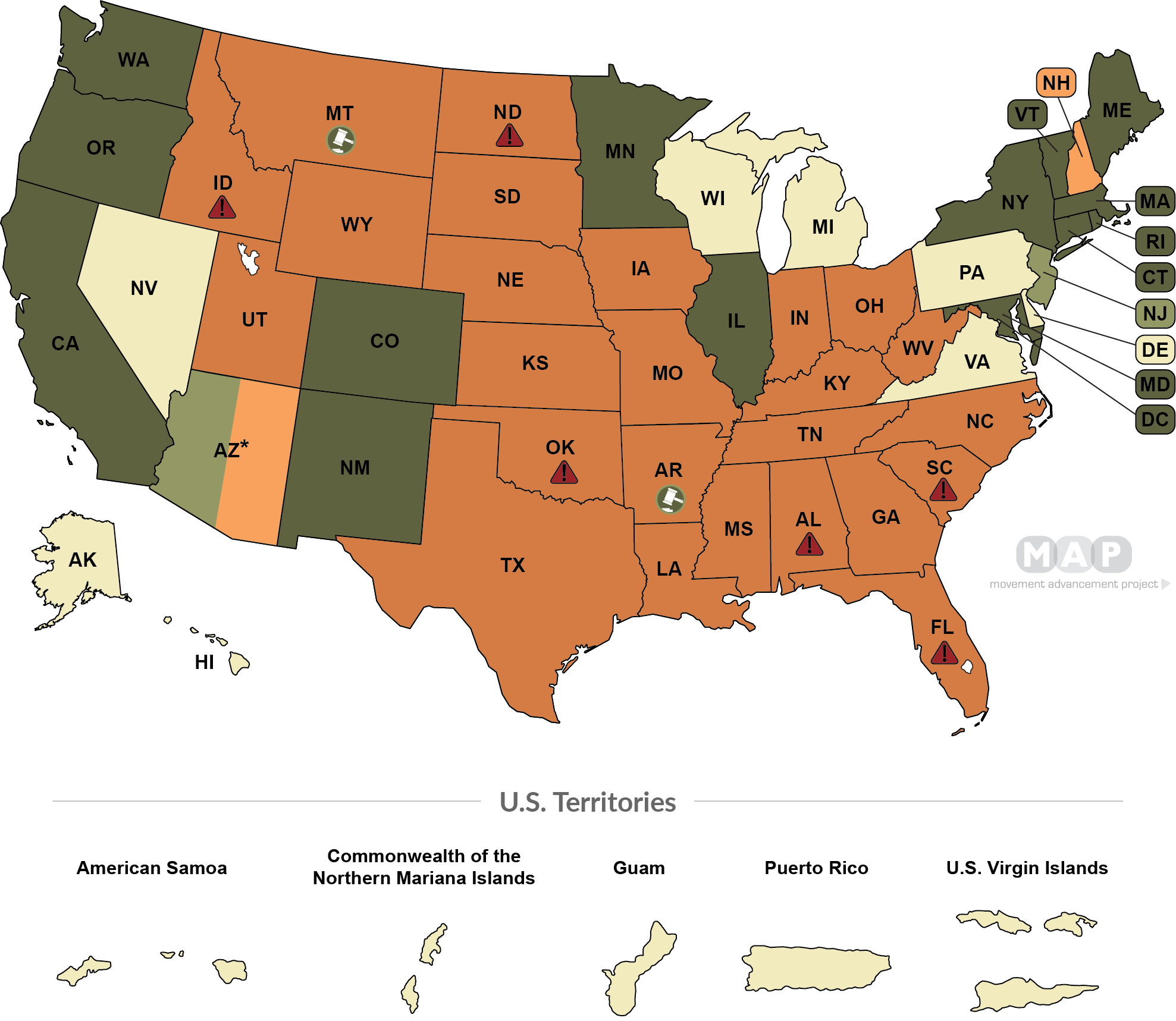
Medical care bans for transgender youth as of April 29, 2025. From lgbtmap.org.
At the end of January, President Donald Trump signed Executive Order 14187, titled “Protecting Children from Chemical and Surgical Mutilation,” on January 28. According to the Center for Reproductive Rights, “The order specifically asks agencies to ensure that hospitals, medical schools, and other institutions receiving federal research and education funding stop providing such care to minors.” Interestingly, the order restricts gender-affirming healthcare for Americans 19 and under, despite the fact that Americans are legally adults at 18.
Previously, President Trump had signed a series of executive orders targeting transgender Americans. Within hours of returning to the White House, he signed Executive Order 14168, “Defending Women From Gender Ideology Extremism and Restoring Biological Truth to the Federal Government,” which stated that the federal government would only recognize binary sex as assigned at birth. He also reinstated the previous ban on transgender individuals serving in the military.
“It is arguably one of the worst times to be trans in the USA since the AIDS epidemic in the 80s.”
H
Restrictions on healthcare could have massive impacts on the physical and mental health and wellbeing of millions of Americans.
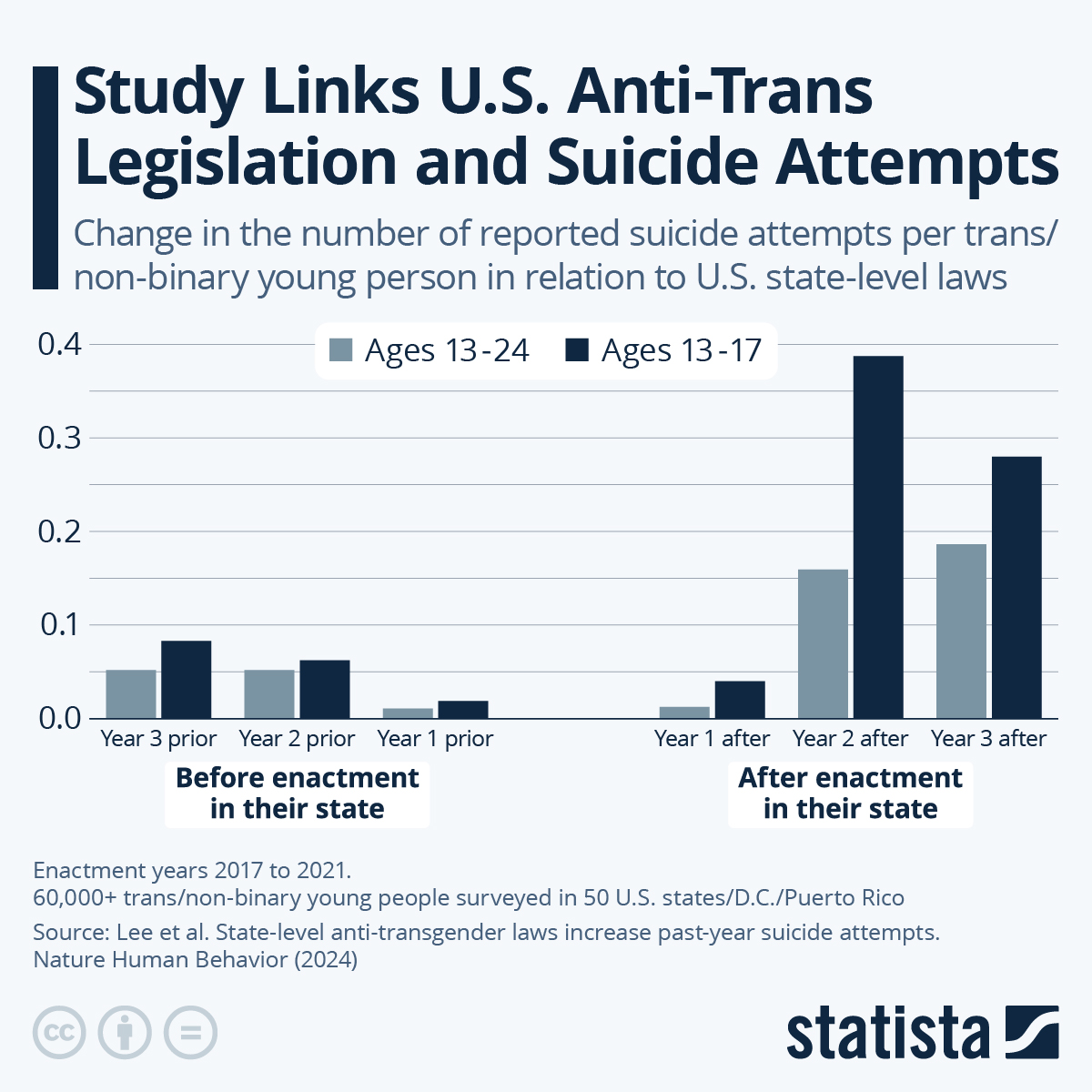
Hormone Replacement Therapy, known colloquially as HRT, is a lifeline for many people who do not feel at home in the sex they were assigned at birth. A study conducted by the Trevor Project found that between 2018 and 2022, “anti-transgender laws significantly increased incidents of past-year suicide attempts among transgender and nonbinary youth by as much as 72%.”
Study Links U.S. Anti-Trans Legislation and Suicide Attempts. From Statista.
A student at Virginia Tech, who has asked to be referred to as H, said “The illegalization of trans medicine will cause the deaths of trans people from mental health. It’s proven that HRT is the #1 way to decrease trans depression and suicide rates. Think of it as a proven medicine to help the known illness of Gender Dysphoria. By eliminating this, you risk the lives of millions.” H also shared their experience being trans at this point in history, saying “it is arguably one of the worst times to be trans in the USA since the AIDs epidemic in the 80s.”
“82% of transgender individuals have considered killing themselves and 40% have attempted suicide, with suicidality highest among transgender youth,” according to the National Library of Medicine. When attitudes shift against the LGBTQ+ community, studies have also shown an increased murder rate of transgender individuals. According to a 2022 article by CBS News, between 2017 and 2021, during Trump’s first term as president, “there was a 93% increase in tracked homicides of trans and gender-nonconforming people in the United States and Puerto Rico.” Around three quarters of these homicides were made up of Black transgender women, despite only 13% of the trans community being estimated to be Black.
Despite the executive order not actually making it illegal to provide gender-affirming healthcare, many healthcare providers rolled back these services immediately out of fear. Virginia Commonwealth University (VCU), the University of Virginia (UVA) and the Children’s Hospital of Richmond have all stopped taking new patients, though they have continued treatment of existing patients. Other providers have cut off prescriptions and other care to all transgender patients indefinitely.
Planned Parenthood and healthcare providers in various states have continued to provide care, although access to these resources may become limited as the Trump administration and various conservative state governments continue to push for further restriction.
These restrictions and the president’s actions concerning immigration point towards potential criminalization. H stated that her “biggest fear is [the government] criminalizing HRT and making it something you can be arrested, deported, or killed over… We have seen in the past few weeks that this administration is not opposed to violating our constitutional rights and strip US citizens of their privileges as American citizens. By criminalizing HRT and making it an offense similar to addictive drugs, you create an easier path to deport undesirables.”
This is not the first time that moves against transgender healthcare have been seen as a jumping off point for more extreme measures. In Germany in 1933, a group of youth who supported the Nazi movement broke into the Institute of Sexology and burned every book in the library. According to an article by Erin Reed, “the institute housed tens of thousands of books, research notes, and data documenting the first decades of scientific study on transgender and queer people.” Members of the LGBTQ+ community have seen the simultaneous moves against birthright citizenship and against LGBTQ+ identities as an echo of the past and a warning of what could follow.
“We have seen in the past few weeks that this administration is not opposed to violating our constitutional rights and strip US citizens of their privileges as American citizens. By criminalizing HRT and making it an offense similar to addictive drugs, you create an easier path to deport undesirables.”
H
H sees it as the Trump administration “trying to make the act of being Transgender illegal. They are trying to do the most spelled out bigoted end of transphobia… this is pretty clearly an attempt to eliminate all trans people.”
Many transgender people are worried about being targeted for being themselves in public or speaking up about their fears. H is anonymous here for that exact reason–to avoid the potentially deadly repercussions of sharing her experience being trans.
The fact that this executive order defines “minors” as people 19 and under also has members of the LGBTQ+ community concerned. While this could be due to the fact that some states have higher ages of adulthood than the federal government, some are worried that it is being used as a stepping stone towards banning gender-affirming care for transgender adults as well.
Overall, this is a volatile time for healthcare for transgender Americans. These restrictions, as well as the fear of new ones, will have a negative impact on the health and wellbeing of millions of Americans. Despite this, the community holds strong. H says that “there is an increased sense of community that comes out of hard times like this,” and that being around a community of other trans people is what “makes living through these times bearable.” In the midst of growing uncertainty and fear, this resilience and unity may provide some hope, as well as a reason to keep going despite the administration’s efforts otherwise.

 > THE NEWS FEED <