
By Kyndall Hanson, education reporter
Public schools provide a free, accessible means of education to children across the country. However, in recent years, parents have expressed worries regarding various aspects of the system, with many looking toward alternative means for schooling their children.
“I am a proponent of public education,” said Charles Lowery, associate professor of educational leadership at Virginia Tech. “I think that public school, in a democratic republic, is a necessity – we have to have them.”
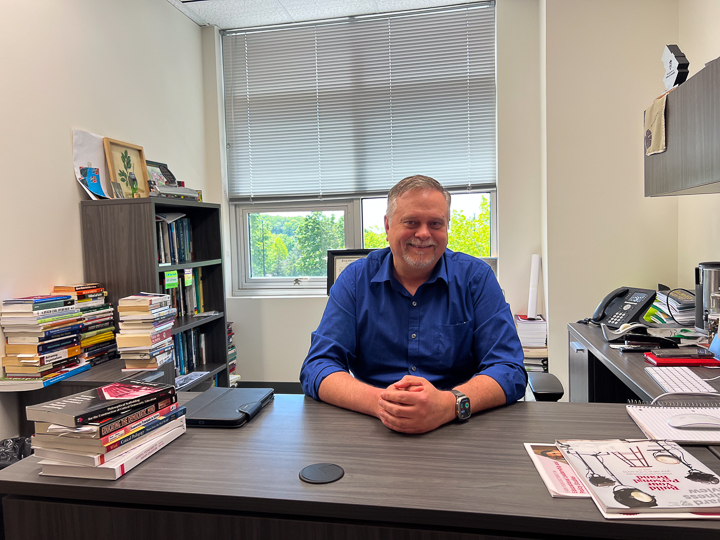
Sitting at his desk surrounded by stacks of books, many with variations of the word ‘education’ plastered on the spine in bold letters, Lowery reflected on the mounting distrust and discontent toward public education expressed by parents across Virginia.
“Political rhetoric drives a lot of distrust,” said Lowery. “There’s been an increase in distrust in education for years; we’ve had this misinformation about what’s happening in K-12 schools.”
According to Cardinal News, Virginia’s public school enrollment rate is projected to decline 2.9% by 2029, with drops stemming from a declining birth rate and increased enrollment in private and homeschooling curricula both during and after the COVID pandemic.
According to data obtained by the Johns Hopkins School of Education’s Homeschool Hub, from the 2023-24 to 2024-25 academic year, homeschooling rates in Virginia increased by 4.34%, with over 56,000 homeschooled students currently enrolled in the state. The data also reflects that significant gains were made during the COVID pandemic, with a 55.79% increase in homeschooled students from the 2019-20 to the 2020-21 school year. While gains have fallen since this period, the number of homeschooled students remains in the 50,000s.

Christine Berry, a parent in Virginia, started her journey with homeschooling during COVID in Pennsylvania. She describes that since then her family has tried both private and public schooling, with one of the motivators for their move to Virginia being the resources and opportunities allocated to children in public schools.
While some families like Berry’s have moved back to the public school system, others have continued to embrace alternative means of schooling – suggesting the COVID pandemic is not the only reason for the continued decline in public school enrollment.
“There’s an author who writes about how back in the 60s and early 70s, there was a shift from being front porch households to backyard households, Lowery described. “… I think COVID pushed us into a new generation of thinking like that, where it pushed us from ‘I feel safe in open areas’ to ‘there’s stuff out there that can not only hurt us but cause conflict between us and our neighbors.’”
Danielle McCoy, a parent in the New River Valley with children in public school, describes that communication is a poignant issue informing her perspective on public school. McCoy says that if she could, she would “pull both of [her] boys and homeschool in a heartbeat.”
“My issue mainly is communication and not being able to see what they’re learning,” said McCoy, describing her experience with the lessening connection between her and the school as her son moved from elementary to middle school. “I don’t feel like locally, I can’t speak for everyone in Virginia, that our school board or our administrators really listen to parents.”
Both McCoy and Berry describe a desire to have a greater say as parents in what curriculum is being used to teach their children, voicing concerns with administrative decisions across public schools.
“It’s like everything has moved away from actually teaching and doing a lot of hands-on things,” said McCoy, considering her two sons’ respective learning experiences. “Don’t get me wrong, there are some amazing teachers, and I support them fully, but there is a slight disconnect between what [children] need to survive in real life and what they need to learn versus what they’re learning on paper.”
In Virginia, curriculum is determined largely at the state level, with Standards of Learning (SOLs) serving as a standard to measure students’ learning across the state.
While these standards are determined at the state level, according to the Virginia Code, local school boards are responsible for “implement[ing] the Standards of Learning or objectives specifically designed for their school divisions that are equivalent to or exceed the Board’s requirements.”
According to Virginia Mercury, the majority of Virginia’s school boards are elected, with 15 being appointed by local governance. For parents, this means having a say in curriculum can take place at the ballot box.
“There is room there for parents to have a voice in curriculum…” said Lowery. “In the United States, we value independence and individualism. So, a lot of times you feel like, ‘well, my personal voice wasn’t heard.’ In a Democratic Republic, it’s everybody’s voice coming together – and we’re trying to capture that. I think education has always attempted to do that.”
SOLs and Measures of Academic Progress (MAP) standardized testing can be a major point of contention for parents with children in public school.
“The stress they put on these kids is insane,” said McCoy regarding MAP testing in her local school district. “I feel like they’re constantly readying them for a test, and there’s not real educating going on.”
Lowery describes that SOLs can be limiting for educators, as well as students. With teachers and administrators working to accommodate and fulfill state testing standards, they may feel as though they have little room to explore other areas of interest with students, “narrowing” learning for children in K-12 public schools.
“[Standardized testing] is one of the areas I’m definitely, as a parent myself, I’m very sympathetic with,” said Lowery as he recalled his experiences navigating testing as an educator and administrator. “But it’s our legislators that we vote in who keep putting this standardized testing in place, not schools.”
With over 20 years dedicated to education, Lowery describes his worries that while many concerns with public schooling, like testing, are apparent in the system, other concerns cited in the news and across social media, like the teaching of controversial content, are often heightened by political rhetoric.
McCoy describes that she feels the material her children are exposed to are often based on opinion, a sentiment shared by many parents across social media and in conversations surrounding the state of education: “I don’t want my kids to learn a teacher’s opinion,” said McCoy. I want them to learn facts.”
Likewise, Berry describes feelings of wanting to have a greater say in her children’s educational environment, expressing discomfort with administrative decisions in areas surrounding what content is allowed in libraries.
Federal and state actions in recent years regarding public school curriculum have often centered around regulating the content taught in schools, such as Virginia Governor Glenn Youngkin’s Executive Order entitled “Ending the use of inherently divisive concepts, including critical race theory, and restoring excellence in K-12 public education in the commonwealth.”
“Divisive concepts can become a catch-all for all manner of things that make us feel ‘uncomfortable,” said Lowery, discussing parental dissatisfaction with K-12 curriculum. “Learning new information, whether it’s history or algebra, can make us all in different ways feel ‘uncomfortable. Too often, it’s guided by political perspective and not pedagogical means, and that’s led some parents to want more control over what their kids are taught.”
Public education, at large, is facing significant changes, no matter the source – from potential funding changes with the elimination of the Federal Department of Education to greater parental involvement in learning.
Even as some parents steer away from this avenue of schooling, public schools remain the largest source of education for children in Virginia; according to the Virginia Department of Education, 1.2 million students were enrolled in public schools during the 2024-25 academic year.
“The part that scares me [about homeschooling] is are we making these decisions based on a lack of information or maybe too much misinformation,” said Lowery. “Are we making these decisions on our emotional decision-making facilities, or are we basing these decisions on what’s best for my child? There’s a huge world between that, and I don’t fault people who want to homeschool their children. There’s legitimate reasons why a person may want to homeschool their child, but there are also reasons that are not grounded in the reality of what happens in education.”
 > THE NEWS FEED <