
By Caroline Herbert, arts and culture reporter
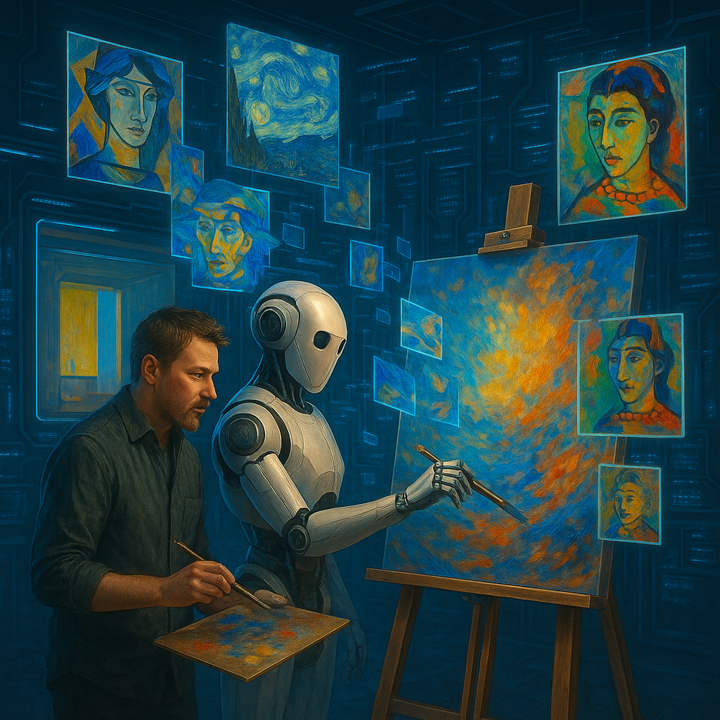
The above image was generated by ChatGPT.
“The great thing about AI is it makes a lot of things more convenient, and the bad thing about AI is it makes a lot of things too convenient.”
-Dr. Justin Horn, Professor of AI Ethics at Virginia Tech
Dr. Justin Horn, a Professor of AI Ethics at Virginia Tech, recently had an eye-opening experience with artificial intelligence.
“I was thinking about unique ways to teach something in particular for class and thought it would be useful to have a cartoon conversation explaining the material I was teaching,” Horn said. “I asked ChatGPT to create this image, and it created exactly what I needed in a matter of seconds.”
As tools like ChatGPT and DALL-E become more widely used, professionals are incorporating AI into their daily workflow. The nature of human creativity is shifting fast. This has sparked a growing debate: Are we witnessing the expansion of art, or its transition into automation?
AI’s ability to generate visual art has created a new creative space, where machine-generated and human-made art intersect. For some, this signals a new era of artistic innovation. For others, it raises difficult questions about authorship, value and authenticity.
AI is changing how creators think, conceptualize and execute their work, presenting both opportunity and controversy.
Savannah Penven, exhibitions program manager at the Moss Arts Center, has extensive experience working with various artists. While the Moss hasn’t actively sought artists who work with AI, she’s observed firsthand how technology is influencing creative work.
“Artists who are already engaging in visual art have found ways to use AI to their advantage,” Penven said. “But also, a lot of people who haven’t really engaged with the arts before are dipping their toes in, and I think that comes from a feeling of not being able to create art themselves.”
Penven’s observations highlight one defining characteristic of AI tools: accessibility. Now, anyone with an idea and just a few descriptive words can produce high-quality art or design in seconds. For some, that’s empowering. For others, it’s worrisome.
Regardless of viewpoint, the ability to instantly create polished, visually appealing art from a text prompt is significantly transforming artistic expression and impacting the creative process.
“We’re already at a point where AI-generated music and art can fool professionals. That’s one of the things I find most unnerving, that even the most human forms of expression are being created by machines.”
-Dr. Justin Horn
Horn explained that most generative AI models are trained on massive datasets, often created using artists’ original work without permission, compensation or credit. This raises several questions about ownership.
“When someone creates a work of art, there’s a sense in which they should own it,” Horn said. “But a lot of the AI systems we have now are trained on huge quantities of artwork, and we don’t have any system in place for compensating the original creators.”
In 2023, several artists filed lawsuits against companies including Stability AI, Midjourney and DeviantArt, alleging that their artwork was used to train AI image-generation models without permission. The case, Andersen v. Stability AI, highlights the legal gaps surrounding intellectual property and creative AI. According to the Copyright Alliance, the plaintiffs claim their work was repurposed without consent.
A report by the Interaction Design Foundation, states that AI-generated art “challenges traditional notions of authorship, intent, and ownership.”
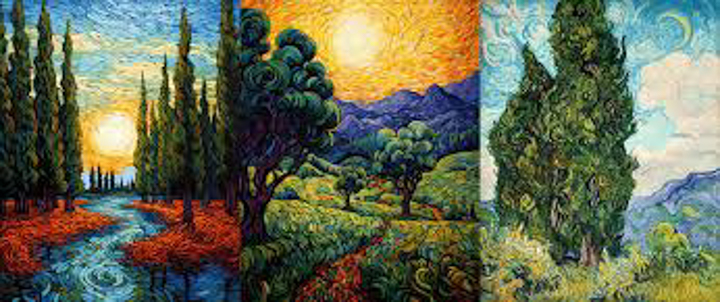
One Van Gogh painting (far right) alongside two pieces of AI-generated art: Image retrieved from Goldpenguin.org
While AI can mimic artistic styles, Penven argues it still lacks one essential element: emotion. Human art, she said, remains distinctive because of its emotional drive.
“The core draw of art is still its personal, emotional connection to the viewer,” she said.
Penven said AI can serve as a useful brainstorming tool, but the line between collaboration and creation matters.
“AI can be helpful in conceptualizing different ways of creating art,” she said. “But when it’s used just to produce a final product without any intention behind it, that’s when it gets messy.”
She compared today’s debates about AI to the 19th-century resistance against photography, another technology that disrupted how people viewed art.
“There’s always been this battle of, ‘Is it art or is it not?’” Penven said. “AI is just the next chapter, just as photography was a new chapter at one point in time.”
“Do people want to view something that is aesthetically pleasing, which AI can certainly generate, or something that reflects the inner world of an artist?”
-Savannah Penven
Beyond the arts, Horn sees additional risks, especially as an educator. He worries about students taking advantage of AI on assignments, but his deeper concern is the long-term cost of dependence.
“It’s very easy to let AI do things for us rather than struggle through them ourselves,” Horn said. “And if we don’t struggle, we risk losing the ability altogether.”
Even something as intimate as a love letter, he warned, could soon become a task people will be tempted to use AI to write.
Whether it’s composing letters, conducting research or developing original ideas, Horn cautioned that consistent shortcuts can hinder one’s creativity.
“We’re moving into a world where it’s going to be very tempting for things not to come from human beings,” he said.
Horn compared the future of art to the fashion industry. While custom-made clothing still exists, most people buy mass-produced clothing made by machines.
“I don’t think human art will die,” he said. “But it might be seen as more of a luxury.”
Despite his concerns, Horn doesn’t reject AI altogether.
“In medicine, AI can detect cancer earlier than a human can,” Horn said. “If the goal is to save lives, I don’t care if it’s a machine or a person doing the diagnosing.”
Still, he noted, there’s a profound difference between scanning a medical image and composing a symphony.
That difference, Penven believes, is what will make human art irreplaceable.
“There’s always going to be people who want to see something created by a human,” she said. “We have this intrinsic drive to create art.”
“AI is here,” she added. “And we’re going to keep finding new ways to deal with it.”
As the creative world adapts, one thing remains clear: AI isn’t going away, and neither are the artists.
 > THE NEWS FEED <