
By Bethany Lenhardt, crime, safety and justice reporter
Biking as transportation is valuable for various reasons, however, biking quickly loses its charm if safety is not a priority. Everyone on the road – bikes, cars, pedestrians – contributes to the safety of the environment and must recognize their role.
“I’ve seen a number of benefits from bicycle commuting. Cycling to and from work and when I run errands is a way for me to get some exercise,” said Nicholas Quint, Sustainable Transportation Manager at Virginia Tech. “Also, I’ve been able to save a lot of money from gas and just the other maintenance related expenses with the car, and yes, there are maintenance related expenses with a bicycle, but to a much lesser degree.”
Quint is based out of Virginia Tech’s Transit Center, located off Perry Street Garage. Inside the center is office space, a break area for Blacksburg Transit drivers and the Hokie Bike Hub.
The Bike Hub is a self-service repair station, where passersby can come in and learn techniques and use the tools to execute repairs, but no items are available for purchase; they do not sell any parts as per an agreement with local bike shops. If an individual comes in with a bike that needs new parts, the Bike Hub workers will help them understand what they need to purchase to successfully execute repairs. They aid approximately 3000 people every year, according to Quint.
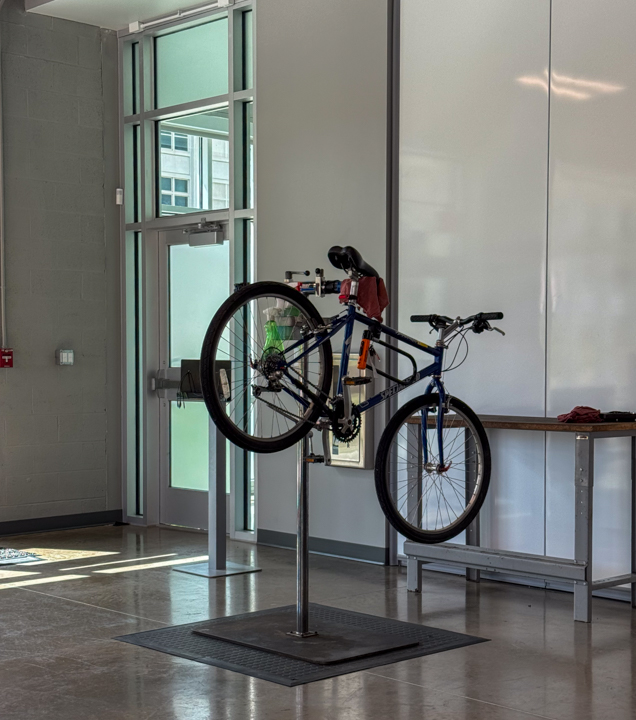
Hokie Bike Hub garage space. Photo by: Bethany Lenhardt
“The Hokie Bike Hub is a learning laboratory,” said Quint. “We are a space dedicated to hands on learning when it comes to working on your bicycle or even an E-scooter, unicycle or skateboard. Our staff are there to teach them how to how to work on their bicycles. We don’t perform any work for folks, and if the problem is bad enough that someone needs to replace a part, we can put together a parts list for them to wherever they can go to get those and then help them out once they have them on hand.”
“The Hokie Bike Hub is a learning laboratory.”
Nicholas Quint
The emphasis on learning is purposeful. Ultimately, a bicycle is a mode of transport and also a vesicle of the rider’s safety. Proper care and upkeep of a bike is step one to ensuring the rider arrives at their destination safely. The Bike Hub and local bike shops help to ensure the bike remains in top running order and that the rider obtains the skills to fix issues on the fly.
Another factor in bike safety is appropriate behavior. According to the Virginia Department of Motor Vehicles, bicyclists are subject to many of the same laws as those in motor vehicles. Additionally, drivers are subject to additional laws to prioritize safety in the shared space. These include keeping at least 3 feet of berth, including the mirror, and slowing down when passing a bicyclist on the road and changing lanes if this operation is not possible.
Bikes may be ridden on and off roadways, excluding all Interstate Highways and when posted signs prohibit the activity. The bicyclist must act like a pedestrian when on the sidewalk, and act like a vehicle when on the road. Cherry-picking and being unpredictable with what laws they choose to obey endangers everyone involved.
“Weaving in and out of traffic so that you’re unpredictable is not helpful; it’s dangerous,” said Quint. “It’s how others perceive you and expect your next move. Using hand signals, like when you’re going to turn, is also important.”
The third aspect of safety is equipment, specifically a helmet. Virginia does not have a state bicycle helmet law; however, localities can choose to require the use of helmets by adolescent riders age 14 and under, in accordance with Virginia Code §46.2-906.1. The localities that abide by this rule can be found on the Virginia Department of Transportation website.
Even with local ordinances, enforcing the use of a helmet is incredibly difficult given the number of children riding bikes at any time, says Dr. Barry Miller, Director of Outreach and Business Development for the Virginia Tech Helmet Lab. However, he highly recommends that everyone – regardless of age – should wear a helmet.
“We have research that shows any helmet will drastically reduce 70 to 80% risk of concussion versus no helmet at all,” said Dr. Miller. “Helmets do wonders.”
“Helmets do wonders.”
Dr. Barry Miller
The Helmet Lab seeks to quantify and understand what happens inside the helmet during real-life head impacts in order to evaluate which helmets are the safest for the activity. It all started with the football department asking Dr. Stefan Duma, the founder of the lab and a professor of biomedical engineering and mathematics, if he could determine the safest helmet for the team. Having just returned from a conference that demonstrated sensors inside military helmets, he was inspired to conduct an experiment.
“We started putting sensors inside football players helmets,” said Dr. Miller. “They agreed to be subjects, so there was 50 players that we collected data on for the initial five years, and basically what we figured out is, when they got injured or concussed on the field, we started pairing that with what the helmet data tells us in linear and rotational head accelerations. From that, we created a bivariate risk function so when certain levels of acceleration are hit, the probability of concussion goes up.”

Virginia Tech Helmet Lab test rig. Photo by: Bethany Lenhardt
The fundamental question is: How does an individual hit their head when they do X? They replicate that impact with test rigs in the lab and have created a system based on a summation of tests and data that determines which helmet better reduces the rapid head movements and therefore gets a better rating for the purpose of wearing it for that activity, specifically. They have set-ups that are unique to the sport, including one for cycling. That system is patented and was named the star rating system. These ratings are publicly available on their website.
“The star ratings are consumer facing,” said Dr. Miller. “Part of our public service mission is to inform consumers on the relative difference between helmets. Just like any other thing, there’s product differentiation. Consider a Fiat versus the Ford F-150; there’s huge safety differences between those vehicles, and even in the everyday products you buy at the grocery store, you know, is it name brand or is it off brand?”
Various helmets in the United States require certification to be sold because of safety concerns. Bicycle helmets are certified by the Consumer Product Safety Commission and must pass their standards to be compliant with the Consumer Product Safety Act. According to the CPSC, they certify a helmet when it passes four tests: it doesn’t block the rider’s vision, it doesn’t fall off when the rider falls off the bike, the straps don’t stretch enough to allow the helmet to fall off or become too displaced, and that the helmet “significantly reduces” force to the head when hit.
“We’ve really revolutionized sport helmets,” said Dr. Miller. “Helmets must be certified at some organization. Bike helmets are the Consumer Product Safety Committee, football are the National Operating Committee on the Standards of Athletic Equipment, etc. All these different organizations control basic helmet performance and the point to pass or fail is catastrophic head injury, so skull fracture and death. The helmet lab has developed assistance, and we supplement those mandatory certifications to be legally sold with real world sport specific helmet ratings.”
While serious bicycle crashes are a major reason to wear a helmet, even a simple fall that results in hitting your head on the ground can be dangerous. The National Safety Council reports that there were 1,377 preventable bicycle crash deaths in 2023. Additionally, they report that “The number of preventable nonfatal injuries also increased by 1% in 2023 but has declined by 29%, from 480,212 in 2014 to 341,774 in 2023.”
Given these statistics, it appears to be imperative to wear a helmet to prevent serious injury, although no amount of precaution can stop the most serious of accidents. Numbers aside, Quint still recommends biking as a source of happiness and perspective, what he calls “bike joy.”
“I acquired a bike shortly after moving to Richmond,” said Quint. “After a semester, I sold my car; I was kind of bicycling out of necessity but also to experience what that was like because there are some people that driving a car is not an option for them, so I thought it was important for me to gain that perspective. Most of the time you get on a bike, and you just can’t help but smile and be happy about it. I think that bike joy, as they call it, is another big benefit.”
Whether a rider chooses to bike for purpose or pleasure, putting effort into the bike’s upkeep remains a top priority for safety on the road. Additionally, familiarizing oneself with local ordinances and obeying the rules can help prevent accidents. Finally, purchasing and wearing a highly rated helmet can help reduce fatal injury in the event of a crash.
 > THE NEWS FEED <