
By Elizabeth Hill, education reporter
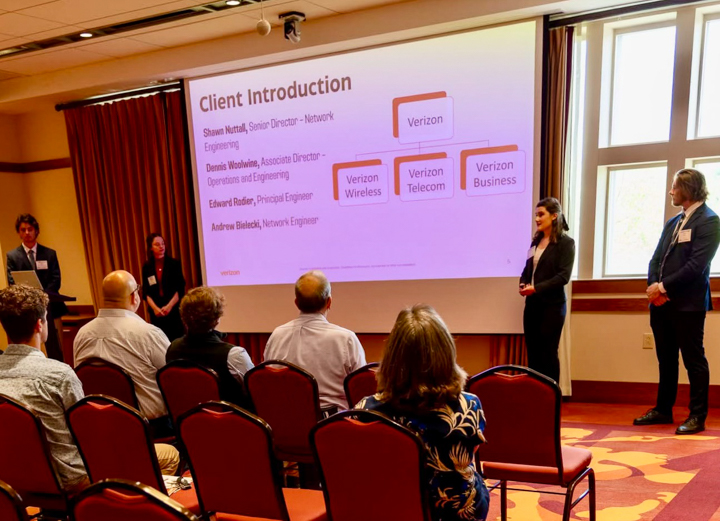
Each fall, a new cohort of Virginia Tech industrial and systems engineering seniors begin the final phase of their undergraduate journey, not with exams or essays, but by solving real problems for companies.
The senior design program, part of the Grado Department of Industrial and Systems Engineering, challenges students to serve clients worldwide over a nine-month period. Teams are paired with company sponsors and have the responsibility of analyzing data, improving systems and delivering tangible results.
Students meet with their clients regularly to align goals, ask questions and present their work in progress. These clients are more than just evaluators; they are active collaborators who offer insights from their own industry experience.
At the end of the academic year, their findings are presented at the Senior Design and Undergraduate Research Symposium, a professional conference where students deliver their findings to faculty, peers and industry representatives. The 2025 symposium was hosted at the Skelton Conference Center, located within The Inn at Virginia Tech. Recognized as the premier event facility in Blacksburg, the venue offers advanced technological resources and a seasoned events team, making it a preferred location for high-profile academic and professional gatherings.
Eileen Van Aken, department head of the Grado Department of Industrial and Systems Engineering (ISE), shared her thoughts on the program’s impact with Virginia Tech News. “It is remarkable to see the impact of our senior design program at such a high level,” she said. “We continue to be impressed by our students and their commitment to delivering strategic, timely, and cost-effective solutions to their clients within our senior design program. We know this real-world experience will be applicable long after they graduate.”
For students, that impact goes beyond academic achievement; it becomes a defining moment in their education. After years of lectures, labs and exams, senior design projects offer a rare opportunity to step into the role of a professional and tackle the kind of complex problems they will likely face after graduation.
“Getting the chance to integrate skills from almost every class in the ISE curriculum was truly special. It put a lot of the theories and formulas that might not be intuitive in a textbook into context.”
Vivek Gopalam, a senior design team member for The Boeing Company
While the academic value of these projects is undeniable, many students found the hands-on, off-campus components just as impactful.
The excitement of leaving the Blacksburg campus and traveling for on-site company visits added an intriguing and memorable layer to the projects. “Pick a project that travels, as I got to go to Colorado twice and Chicago once. All amazing experiences,” said Matthew Speciale, a senior design team member for Woodward. For Speciale and his team, their trips to Fort Collins, Colorado, were among the highlights of their senior design experience, offering both professional insight and personal adventure.
Speciale’s team visited Woodward’s facility on two separate occasions, each lasting a week, to gain hands-on experience and a deeper understanding of the project they were tackling. These on-site visits allowed them to work directly with the company and gain crucial insight into the operational side of their project.
When the team was not present at the facility, the students took full advantage of Colorado’s natural beauty. From skiing at Winter Park to hiking in Rocky Mountain National Park, the students experienced the perfect blend of professional growth and personal adventure.
For Speciale and his team, the combination of immersive work and unforgettable travel made their senior design project not just an academic requirement, but a defining chapter in their Virginia Tech experience.

For Mollie McKee, whose team partnered with Verizon, the early weeks of the project were filled with uncertainty. Unlike projects with clearly defined deliverables, her team’s assignment came with an open-ended scope. The lack of structure was challenging at first but ultimately led to valuable learning.
“Our project was not strictly scoped in the beginning, which made for a really interesting first few meetings,” McKee said. “We set expectations and did the usual team bonding activities, but we really started to dive into the project once we visited one of the sites.”
Each semester, students in the senior design program receive a list of industry-sponsored projects that outline genuine engineering challenges. After reviewing their options, the students rank their top choices. Teams are then matched with companies ranging from global tech firms to defense contractors, offering students hands-on experience in industries they may have never explored.
For McKee, that meant stepping into unfamiliar territory.
Drawing on her previous internship experience, she described the program as a very abbreviated version of an internship. However, unlike her prior roles, this project required her to approach problem-solving in a completely new environment.
“It was an opportunity to explore a space I probably never would’ve considered otherwise,” she said. “And that ended up being one of the most rewarding parts.”
One of the biggest lessons McKee learned was the importance of listening, especially to the people most closely connected to the issue.
“I think talking to the people who are at ground zero of the problems you’re trying to solve at a larger scale is the most important place to start,” she said. “A lot of people, myself included sometimes, tend to jump to solving problems they don’t understand, and that leads to frustration from those on the ground.”
By embracing the unknown, asking better questions and listening to those with firsthand experience, McKee and her team were able to find direction and purpose. Her experience reflects the heart of the senior design program: not only addressing operational challenges faced by major companies, but learning how to lead, adapt and grow in the face of the unknown.
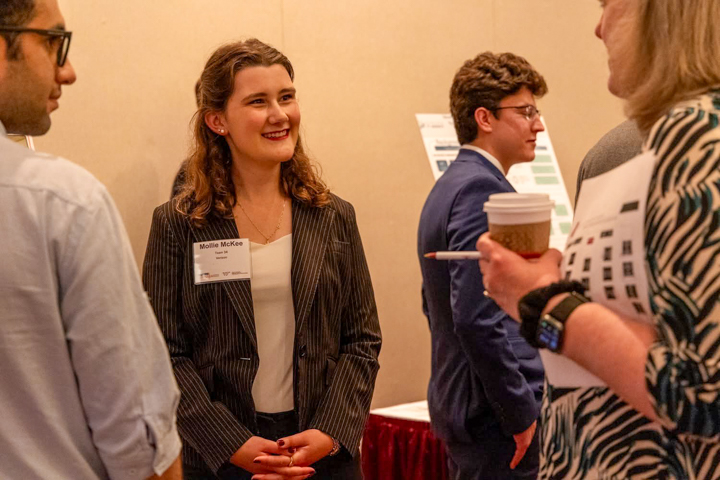
he students’ journeys, filled with discovery, collaboration and growth, came to a close at one of the department’s most anticipated events of the year.
The 2025 Senior Design and Undergraduate Research Symposium marked the final milestone in a yearlong journey of applied problem-solving. Throughout the day, teams presented their findings through formal presentations and interactive poster sessions, engaging with faculty, fellow students, and industry representatives. The event served as both a culmination and celebration of the knowledge and skills students developed during their time in the program.
To close out the symposium, several student teams were recognized for outstanding performance. Awards were presented across five categories: Application of ISE Tools, Project Performance, Innovation and Creativity, Integration and Implementation, and People’s Choice. Each award reflected a different dimension of excellence.
For many students, the symposium was a rewarding opportunity to reflect on how far they had come.
“It was so much fun, and it was nice to reflect on how far we came from the start of the project—showcasing everything to a packed room with your friends and professionals was a great way to end the project.”
Matthew Speciale, a senior design team member for Woodward
Others found the experience validating in terms of industry relevance and technical achievement. “I was very proud of our performance in the poster session and presentation,” said Vivek Gopalam, whose team worked with The Boeing Company. “We had industry representatives come talk to us about how pressing the issue that we were solving was to them, and how exciting it was to see research being done in this area. Our efforts paid off as we were told by the ISE teaching team that we were an extremely high scoring team.”
These recognitions highlighted the program’s emphasis not just on delivering solutions, but on integrating core industrial and systems engineering principles in innovative and meaningful ways.
As the symposium concluded, students walked away with more than just final deliverables, they left with real-world experience, new connections, and a sense of accomplishment. For many, the event was a turning point: the transition from student to emerging professional.
By bridging classroom instruction with practical application, Virginia Tech’s ISE Senior Design program continues to prepare graduates for the complex challenges of the modern workforce, equipped not only with knowledge, but with confidence earned through experience.
 > THE NEWS FEED <