
By Emelia Delaporte
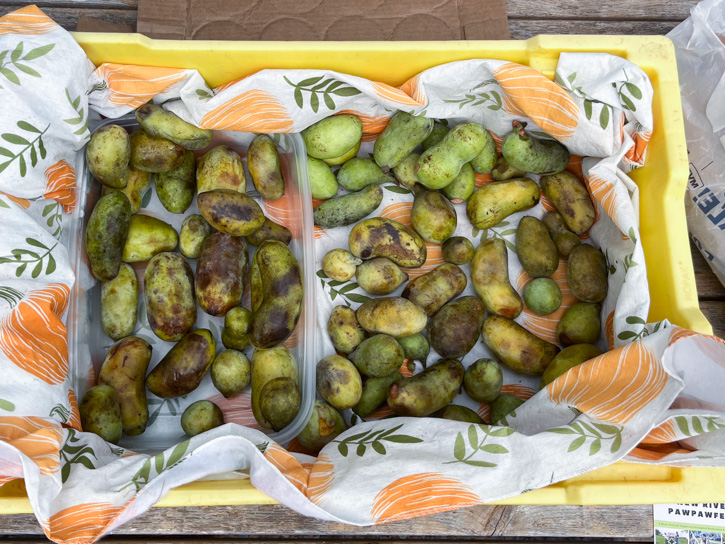
As the first crisp notes of autumn begin to cut through the air, somewhere nearby North America’s largest native fruit falls quietly to the ground. Bewilderingly tropical and often overlooked, the pawpaw is in season and here to stay.
Pawpaws in the New River Valley – they ripen in early September. For a few weeks, they hold a cultural spotlight in the area. With festivals, tasting events and foraging available, this is possibly the best time of year to learn about this unique fruit – and why it is not commercially available.
Despite their lack of year-round availability, and their lack of availability in stores in general, the pawpaw has a loyal following as an edible native. People want it in their hands, in their kitchens and in their yards. Passionate growers like Jesse Kelly are working to make that possible.
“Just in Virginia, the extremes of flavor…. [It’s] often described from banana to mango to cardamom, almost,” said Kelly, executive director of the nonprofit Nursery Natives. “Or a caramel-type flavoring.”
While there is not an abundance of pawpaw-related recipes, due to their lack of longevity, fans find them great to eat as they are or find new ways to use them. Common recipes include pawpaw bread, pawpaw ice cream, pawpaw salsa and more.
Ava Pope, a landowner in Giles County, sources her pawpaws from two trees that her partner planted around 25 years ago. Purchasing saplings has the potential to be wildly successful. With six or seven years of patience, a healthy tree can produce hundreds of fruit with each harvest.
“Trees that produce, we have two,” Pope said. “Between those two trees, we’ve gotten anywhere between 100 and 200 pounds per season.”
Her average pawpaw weighs about a third of a pound, and her biggest one weighs three quarters of a pound. Her two producing trees are six to eight inches in diameter at breast height and around fifteen feet tall.
Pope also has pawpaw trees on her property that were not human-planted. She is not sure whether these other trees were completely wild or whether they sprouted from seeds dispersed from her planted trees.
Either way, typically these other trees do not produce. This could be for a variety of reasons; for starters, they receive less light than the two fruiting trees, which were carefully positioned. These other trees are smaller, potentially from being of a more wild stock, or also due to lack of sunlight, or both.
Additionally, they might be clones of each other, which would limit fertilization necessary to produce fruit. Wild pawpaws sprout most often from suckers instead of seeds. Suckers are sprouts from the roots of an existing tree, resulting in a genetic clone of the original tree. To that end, pawpaws in the wild often exist in colonies, or clonal stands. For those stands to bear fruit, pollen must come from pawpaws outside of the colony.
The two fruiting trees are enough for Pope, though. For her and her eight year old son, Onyx, their fruiting trees are fun to eat fresh, to give away to loved ones and to sell to festivals, farms and more.
“Before we realized that lots of people liked them, they would just rot in the backyard. I think it was five or six years ago I realized, oh, maybe we should do something with these,” Pope said.
Growing your own pawpaws is not always easy, but it does not need to be complicated. John Peterson, an advanced lab specialist at Virginia Tech, grows saplings at his farm.
“I have had really good luck planting larger pawpaws. If they’re three feet high, containerized – almost guaranteed success,” Peterson said. “ Eight inch high, bare root? Almost guaranteed they’ll die. All my successful pawpaws were tall when I planted them.”
If starting from seed, prospective growers will need to wait a while. Pawpaws need a cold, moist stratification period to complete their embryo dormancy period. Putting fresh seeds in damp paper towels in the fridge through the winter will mimic them spending the winter in the ground. Once the stratification period is over, the seeds will be better able to sprout.
Pawpaws do best in a rich, moist soil. According to Peterson, much of their range is underlaid by limestone. This indicates also that they do better with a less acidic – or, sweet – soil. Trees like sugar maple, bitternut hickory and American basswood are possible associates.
They have an expansive range – most of the eastern United States, the southern United States and the midwest have pawpaw species native to them. They even grow north into Canada. Asimina triloba, the common pawpaw, is the local species to the New River Valley and has the greatest range of the multiple species in the Asimina genus.
So far, Peterson says, the range is not contracting or expanding with climate change. However, the tree seems to be proliferating within its pre-existing range. Human development practices like clear-cutting are creating much more space where sunlight reaches the ground, and that is what pawpaw loves most.
This increasing availability of the fruit itself does not mean that shoppers will see pawpaws on grocery store shelves any time soon.
“In order to make [pawpaws] a marketable product, we have to figure out how to store them and ship them… once you’ve picked them, the fruits are only good for like, two days,” Peterson said. “They really fall apart fast, they bruise easily – they are, I think, a terrible marketable product.”
For the coming month, though, they will be marketed at festivals. The two festivals being advertised in the New River Valley are the 2024 Paw Paw Festival in Pearisburg on Sept. 28 and 29 and the New River PawPaw Fest in Radford on Oct. 5.
Hopefully someday, growers and scientists will figure out how to make the fruits last longer. Until then, the most reliable way to get pawpaws will be to know where to forage, to go to festivals or to grow them in your own backyard.

 > THE NEWS FEED <